Prioritisation
Agreeing on completion criteria for a deliverable
Write observable completion criteria with the recipient, separate standing quality checks from deliverable-specific needs and manage changes clearly.

Archive
Prioritisation
Write observable completion criteria with the recipient, separate standing quality checks from deliverable-specific needs and manage changes clearly.
Async Work
Asynchronous work lets people contribute without being online at the same moment. It succeeds when an update carries enough context for the next person to act …
Process Experiments
Check productivity targets for shortcuts, inspect quality and displaced work, and revise measures that misrepresent results.
Team Workload
Plan aftercare, qualified cover, breaks and agreed leave before a major delivery ends, then adjust the next commitments.
Prioritisation
Choose one productivity problem using its consequences, available evidence and ability to act, then investigate without assuming the cause.
Async Work
Decide whether a written update can replace a meeting by checking the purpose, context, response window, owner and need for live discussion.
Process Experiments
Recognise when a thread needs a findable answer, distinguish pending from settled decisions and record the current outcome.
Meetings
Including everyone in a decision can slow it without improving it.
Prioritisation
Review original commitments, completed results and work added later without hiding approved changes or unfinished dependencies.
Prioritisation
Set up a fair trial of direct assignment and a shared intake queue, then compare ownership, usable resolution, quality and effort.
Prioritisation
Assess an urgent work request against current commitments, identify the response window and agree on what moves if it takes precedence.
Prioritisation
Make a realistic weekly plan by explicitly deferring, reducing, transferring or stopping work that will not fit.
Meetings
Teams lose time when a discussion has no named decision, the wrong people are asked to approve it or a settled choice is debated again without new…
Prioritisation
Define a knowledge-work output by its recipient and use, then check quality before relying on counts or claiming a wider outcome.
Prioritisation
Use current commitments, available skills and an agreed work order to tell whether a team needs clearer priorities, more capacity or both.
Team Workload
Use duration, frequency, severity and recovery to distinguish a bounded delivery push from a recurring workload problem.
Prioritisation
Trace scheduled work to usable outputs and intended outcomes without treating a full calendar or unfinished tasks as a productivity score.
Async Work
Manage email and chat workload with clear message routes, routine review times, named owners and accessible decision records.
Meetings
Escalation works when the recipient can decide without reconstructing weeks of discussion.
Prioritisation
Define the work, state a useful estimate and its assumptions, separate effort from delivery time, and update the forecast when the basis changes.
Async Work
Search by purpose, inspect likely matches and decide whether to reuse, update, adapt or start a document from scratch.
Focus
Manage interruptions by defining urgent routes, service coverage and usable focus periods, then check that the whole team’s work still moves forward.
Prioritisation
Turn a vague assignment into a usable result with clear authority, inputs, boundaries and an early checkpoint.
Async Work
A teammate waking up hours later should be able to continue the work without waiting for you to come online. Put the objective, current state and next decision in …
Async Work
Set practical email and chat review times around service duties, with a clear exception route and checks for missed work.
Focus
Trace interruptions to their causes with a brief work-level review, then choose a change that preserves necessary service.
Prioritisation
Spot missing outcomes, audience, scope and authority in a work brief, then ask focused questions before committing to the deliverable.
Process Experiments
Improve team productivity by defining useful results, finding where work stalls and changing the process without adding activity tracking.
Async Work
A decision made in a chat thread or recording can be invisible to the person who joins the project next month. Give it a stable home near the work it governs.
Process Experiments
Assign a template owner, track change triggers, identify the current version and review the template against real work.
Team Workload
Choose what knowledge to keep, make it findable and current, and help colleagues reuse it safely in everyday work.
Focus
Choose what a work-in-progress limit covers, decide what happens when it is full and review blocked work without hiding demand.
Process Experiments
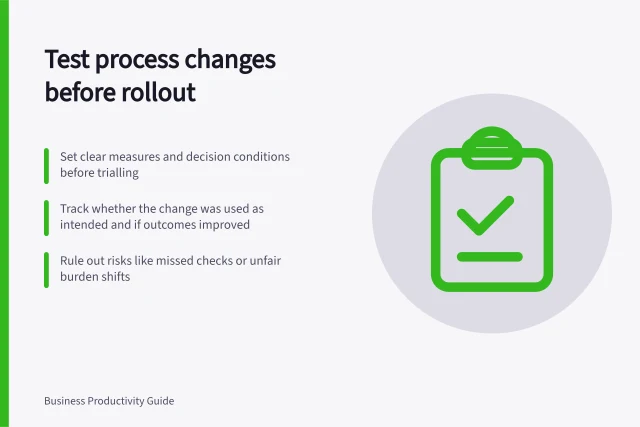
Define a trial’s result, implementation and safeguard measures before deciding whether a process change can be used more widely.
Prioritisation
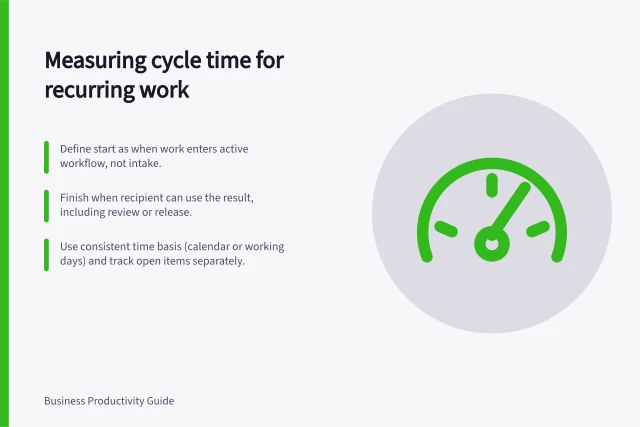
Define start and finish points, track comparable work and interpret cycle time without hiding open items or quality problems.
Meetings
Review a recurring meeting's stated purpose, recent outcomes and participant feedback before deciding to keep, change or replace it.
Meetings
Choose when to meet, prepare around a clear outcome, capture what changed and review whether recurring meetings still help the work.
Prioritisation
Build a personal work plan around commitments, next actions, available time and review points, then adjust it when the work changes.
Focus
Protect time for detailed work by mapping service duties, assigning real coverage and reviewing both delivery and customer response.
Team Workload
Build a workload plan from usable time, skills and service cover, then resolve commitments that do not fit.
Meetings
A team may revisit a decision because the result was never recorded, because implementation is hard or because genuinely new facts emerged.
Prioritisation
A practical guide to managerial productivity: make timely decisions, set clear outcomes, review useful progress and remove obstacles.
Prioritisation
Choose useful team productivity measures and interpret completed work alongside quality, changed demand and employee feedback.
Prioritisation
Find the decisions that need your authority, prepare them for review and protect time to answer without becoming the team's bottleneck.
Team Workload
Triage live duties, arrange qualified cover, revise affected promises and protect privacy when a colleague is unexpectedly absent.
Team Workload
Turn a repeated team question into a short, checked answer with clear scope, a useful location and an owner.
Meetings
A meeting can be full of useful facts and still end without progress because nobody stated the choice to be made.
Process Experiments
Find where completed work returns, clarify briefs and completion criteria, time reviews well and address recurring causes of rework.
Async Work
Choose email and chat recipients by their role, use Reply all deliberately and reserve group alerts for messages the group needs.
Process Experiments
Find the blocked step, choose a remedy that changes it and check whether work can proceed without shifting the problem elsewhere.
Meetings
Triage late review comments, make scope and deadline trade-offs explicit, and set an earlier review point for the next deliverable.
Focus
Use a shared work record, proportionate checkpoints and clear exception rules to review progress without repeated status chasing.
Prioritisation
Check the real state of unfinished work, decide what to advance, wait on, revise or close, and leave a clear starting point for next week.
Process Experiments
Trace a process change across every hand-off to find displaced effort, longer queues or added corrections before declaring a gain.
Prioritisation
If every message is marked urgent, people cannot tell which one needs immediate action. Define urgency by impact and response time, then route it differently from routine status.
Async Work
Agree on response windows, ownership, working hours and escalation so ordinary requests and live service issues reach the right person.
Team Workload
Choose workload signals that reveal timing, effort and role constraints without turning a shared view into a task-count league table.
Team Workload
Find role bottlenecks early by comparing upcoming hand-offs with skills, service duties and available review time.
Process Experiments
Set stopping rules, stabilise open work, investigate added burden and decide whether to end or revise a process trial.
Prioritisation
Plan useful work at a pace the team can maintain. Account for real capacity, deadline pushes, recovery and effort shifted to other roles.
Team Workload
Build a useful view of team commitments, service duties and capacity so workload conflicts lead to clear decisions.
Meetings
Trial fewer or shorter recurring meetings while checking decisions, handovers, support and work shifted into messages.
Team Workload
Keep a simple return record, investigate repeated reasons and check whether a targeted process change prevents the same rework.
Prioritisation
Define a deliverable, divide it into checkable parts, identify next actions and dependencies, and check that the parts produce the agreed result.
Prioritisation
Define the task, select the checks that matter, write clear actions and review the checklist against real work.
Team Workload
Ask employees about workflow friction, interpret responses fairly and keep reported experience distinct from recorded output.
Prioritisation
A practical way to order team work, handle new requests, make trade-offs visible and review priorities against real capacity.
Process Experiments
Choose a work problem, set a bounded process trial, check useful results and unintended costs, then decide whether to keep, revise or stop the change.
Meetings
Build a meeting agenda around the decision, options, essential input and approval route, then close with a clear outcome or next step.
Async Work
An effective update answers what happened, what it changes and what the reader must do. Write for someone who has not followed every message in the project channel.
Prioritisation
Write a work request that names the owner, needed result, relevant context, timing and place for the answer.












![Is your recurring meeting still useful?: Define purpose: 'We meet so that [people] can [do something] and leave with [a result].'; Inspect past sessions using agendas, decisions and feedback from affected teams.; Decide to keep, improve, reduce or end based on whether the result is consistently achieved. Measuring whether a recurring meeting has a purpose](/covers/measuring-whether-a-recurring-meeting-has-a-purpose-640.webp?v=0504aac5)