Async Work
Part of Meeting productivity
Choosing when an asynchronous update is enough
Decide whether a written update can replace a meeting by checking the purpose, context, response window, owner and need for live discussion.
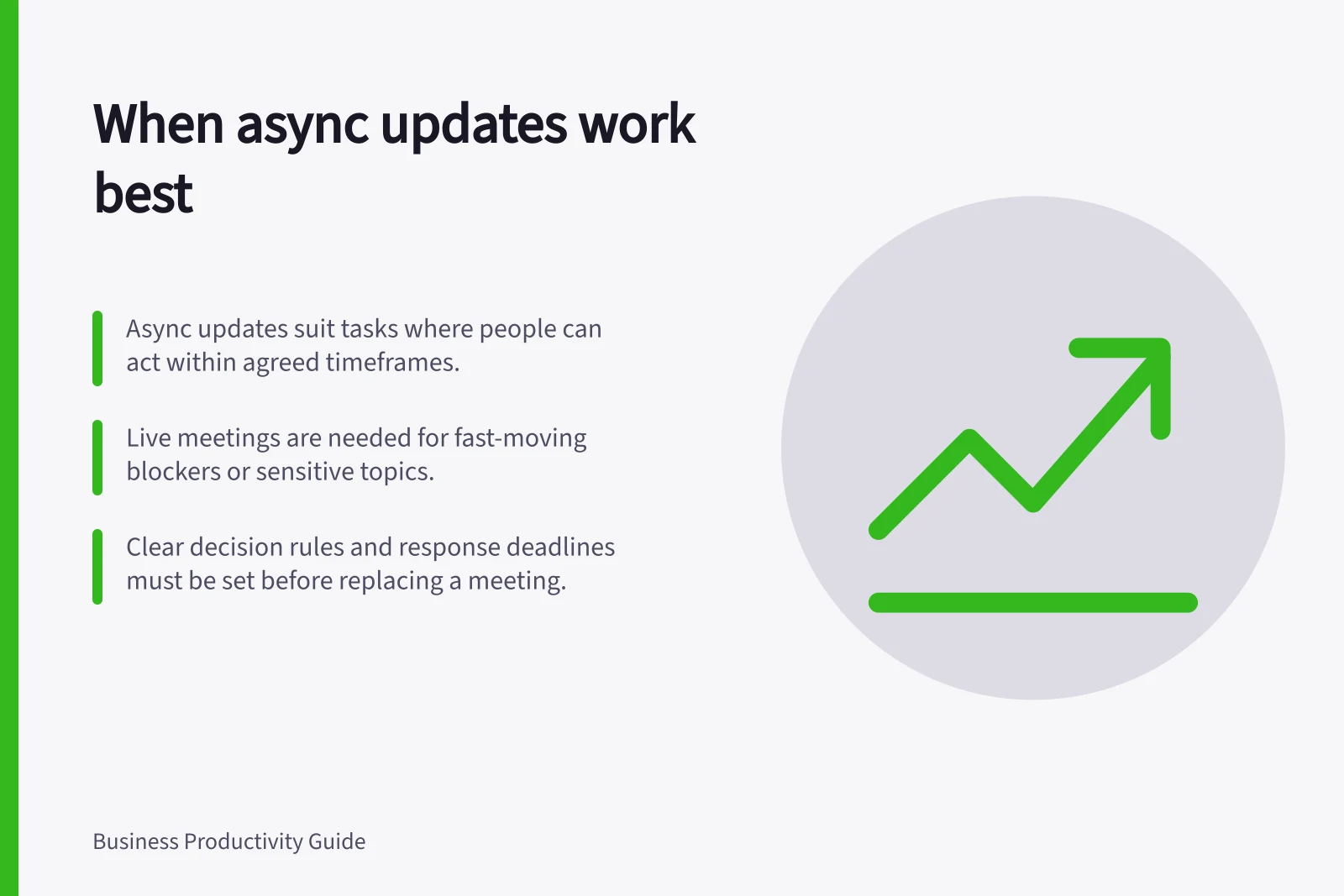
An asynchronous update is enough when people can understand the current position, respond within an agreed window if needed, and continue the work without talking at the same time. Choose a live conversation when the task depends on rapid exchange, a sensitive discussion or a response the update route cannot deliver in time.
Test the proposed meeting
Ask what participants would do together. If each person would report progress while others listen, an update in the agreed work location may be enough. If several people must question one another's assumptions to resolve a blocker, a short live discussion may help. A decision can also be made asynchronously when the options, decision authority, response deadline and approval process are clear.
Judge the task and its timing. Someone handling a live customer issue may need a prompt handover. A colleague in another time zone may offer more considered input when the question is written and the response window respects their working hours.
Check whether the route is dependable
Before replacing a meeting, check that readers will know what changed, whether action is required, who must respond and where the final answer will appear. If basic context would require several follow-up messages, improve the update before relying on it. If replies are likely to change the issue quickly, set a point at which the owner will bring the relevant people together.
Agree who will read the update, when an ordinary response can be expected and how a genuine exception reaches someone on duty. A message in an unattended channel cannot replace a time-sensitive alert. Do not treat silence as approval for a consequential decision unless an authorised process already provides for it.
Match the route to the work
| Situation | Consider | Check before relying on it |
|---|---|---|
| Routine progress with no requested action | Written status in the work record | Can readers find the current version? |
| Specific feedback on a draft | Comments by an agreed deadline | Can people answer the question independently? |
| Choice between stated options | Written decision request | Are authority and approval rules clear? |
| Fast-moving blocker or sensitive discussion | Live conversation | Can the needed people take part, and will the result be recorded? |
A written route may fail if it requires a chain of dependent replies. A meeting may be premature if participants first need time to read the material.
Check the replacement
When a standing status meeting moves to updates, tell participants where to post, who will collect questions and when the arrangement will be reviewed. Look for missed blockers, repeated clarification requests and decisions without an owner.
Ask whether the route helps the people doing and receiving the work; fewer booked minutes alone cannot answer that. If routine information travels well in updates but a particular issue needs discussion, meet for that issue and record its outcome.
![Is your recurring meeting still useful?: Define purpose: 'We meet so that [people] can [do something] and leave with [a result].'; Inspect past sessions using agendas, decisions and feedback from affected teams.; Decide to keep, improve, reduce or end based on whether the result is consistently achieved. Measuring whether a recurring meeting has a purpose](/covers/measuring-whether-a-recurring-meeting-has-a-purpose-640.webp?v=0504aac5)