Async Work
Part of Focus and interruption management
Setting team expectations for response time
Agree on response windows, ownership, working hours and escalation so ordinary requests and live service issues reach the right person.
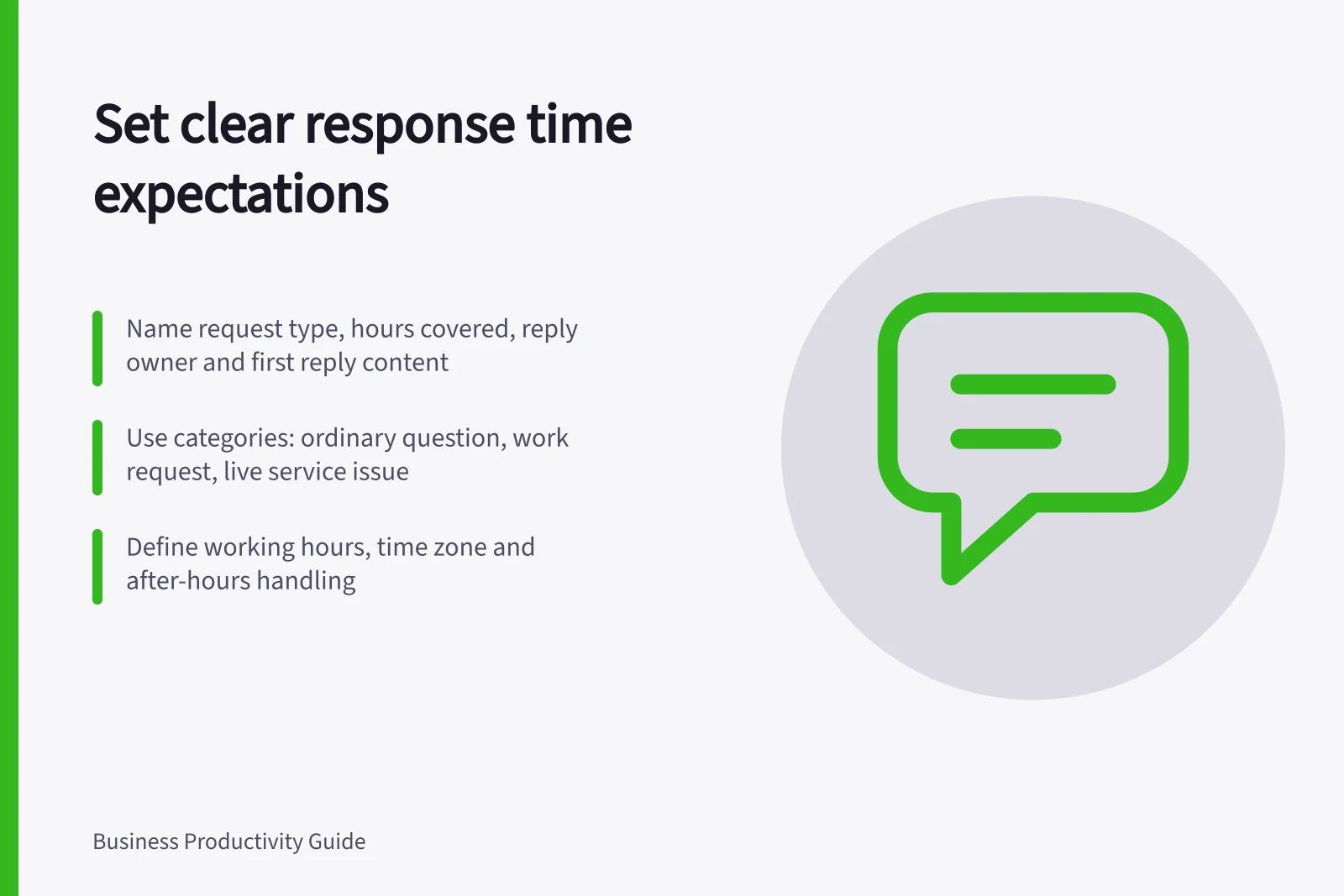
Set response expectations by naming the kind of request, the hours the agreement covers, the reply owner and what the first reply must provide. Keep a separate way to reach the person responsible for a genuine time-sensitive issue. A promise to “respond quickly” tells neither sender nor recipient what to do.
Separate acknowledgement, answer and resolution
A request may need an acknowledgement before anyone can give a complete answer. A customer issue may require investigation after the first reply. State which stage the team is promising so a sender does not mistake “we received it” for “it is resolved”.
Use a few categories that reflect actual work:
| Request | Agree on |
|---|---|
| Ordinary question | Where to send it and when an answer or useful update can be expected |
| Work or decision request | The owner, needed outcome and date by which an answer is useful |
| Live service issue | The monitored route, person on duty and fallback if they cannot respond |
Choose the response windows with the people who will meet them. A service queue monitored throughout a shift can support a different agreement from a project inbox reviewed between other duties. Check demand and cover before committing to a window.
Write the boundary around working hours
Say when the ordinary response clock starts and stops, including which time zone applies when colleagues work across locations. Explain what happens to a message sent after the recipient’s working hours. A sender may write at any time; that does not itself make the message an immediate task for its recipient.
The Fair Work Ombudsman provides information about the right to disconnect and about discussing it at work. Guidance and the employment arrangements that apply to a role can affect what is reasonable, so check the current Fair Work Ombudsman material and the arrangements that apply before setting expectations about contact outside working hours.
Relevant awards, agreements and on-call arrangements may also affect expectations. Check the employment arrangements that apply before assigning out-of-hours cover; an ordinary project message should not quietly become an on-call duty.
Key Considerations for Response-Time Policies
- Fair Work Ombudsman Guidance
- Available on right to disconnect and reasonable contact expectations
- Employment Arrangements
- Awards, agreements and on-call duties affect out-of-hours expectations
- Team Coverage Capacity
- Ensure response windows match actual availability and workload
Make escalation specific
Describe the event that qualifies for the urgent route and the action the sender should take. For example, a live service failure affecting current customers may go to the rostered contact, with a backup if they cannot be reached.
A draft needing feedback next week belongs in the ordinary route even if its sender would prefer an answer today. These are illustrative classifications; the team must define its own consequences and duties.
An escalation rule also needs a limit. If the on-duty person lacks the access or authority to act, name who can help. If routine work repeatedly arrives as an alert, review the trigger and the normal response promise. If real alerts wait unseen, fix the coverage or fallback rather than asking everyone to watch every channel.
Check whether the agreement works
Try the wording against recent requests: could a sender identify the right route, and could the recipient meet the stated window alongside existing work?
Review a small set of cases after the agreement is in use. Look for missed service needs, unnecessary escalations and ordinary requests that waited without a useful update. Ask whether people understand the difference between acknowledgement and completion.
Revise the agreement when hours, service demand or staffing change. If the team cannot meet a reasonable promise without constant interruption or out-of-hours work, change the promise or the coverage with the people authorised to do so. Clear expectations make a response dependable; they do not create time that the team does not have.
Setting Clear Response-Time Agreements
- Define request types and response stagesSeparate acknowledgement, answer and resolution with clear expectations.
- Set working hours and time zone rulesInclude when the response clock starts and stops; clarify after-hours handling.
- Assign ownership and escalation pathsName the responsible person and define what triggers urgent action.
- Review and adjust based on real-world useTest against recent requests; revise if promises aren’t met without overburdening teams.