Focus
Part of Focus and interruption management
Planning focused work around service responsibilities
Protect time for detailed work by mapping service duties, assigning real coverage and reviewing both delivery and customer response.
Plan focused work backwards from the service commitment. Establish what must be monitored or answered, when demand tends to occur and who has authority to respond. Then place focused work where that coverage can continue. A blocked diary is not a coverage plan.
Map the duty before reserving time
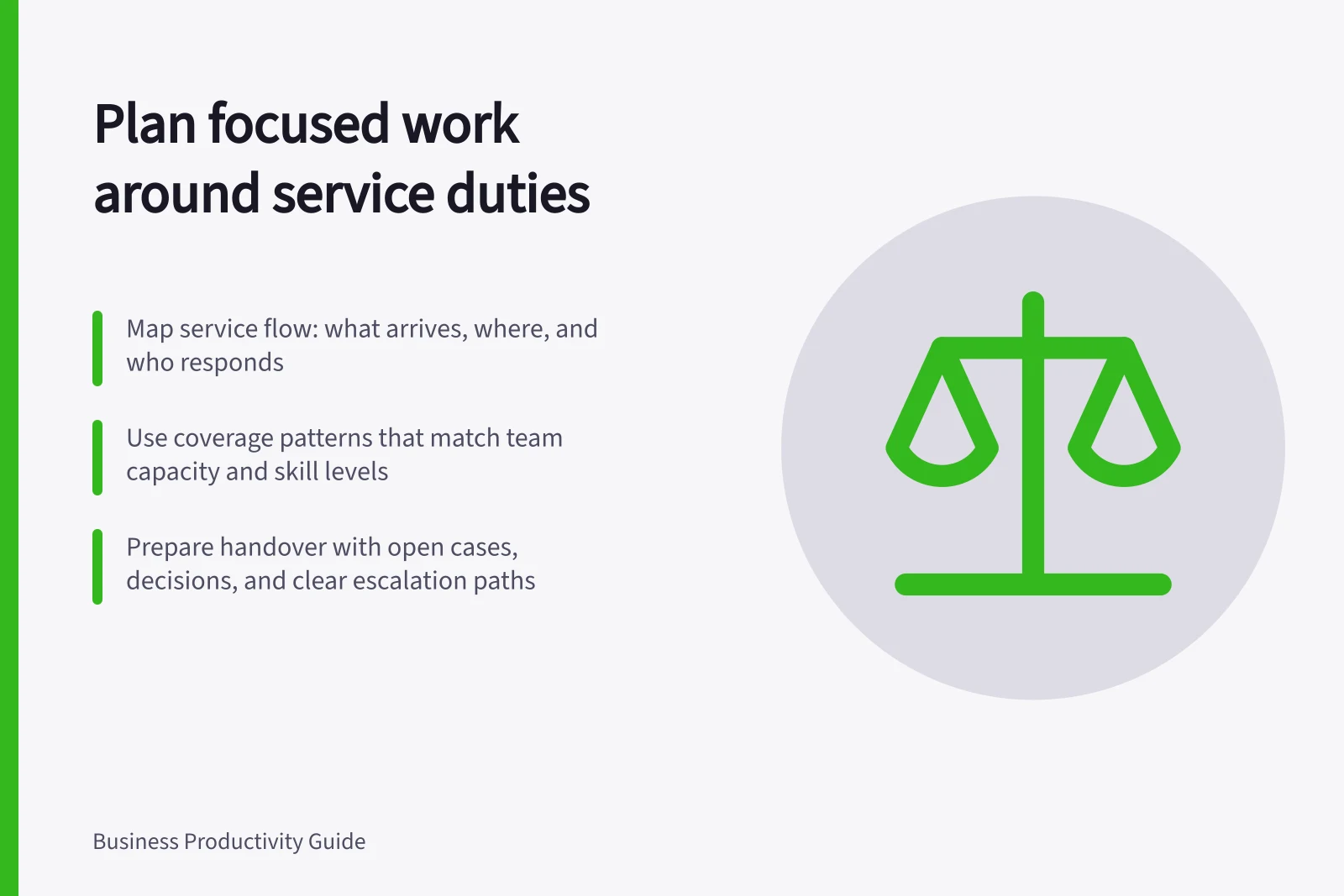
Write down the service route in plain terms: what arrives, where it arrives, the response or handover the team has promised, and which skills or approvals it requires. Include work that is easy to overlook, such as checking an unresolved case or helping a colleague during a customer call.
Ask the people who cover the service when they can safely step away and when they cannot. A quiet period may suit detailed work, but a predictable handover may matter more than choosing the quietest hour. If demand is unpredictable, plan for an interruption and decide where the focused task can be paused without losing its place.
Choose a coverage pattern that the team can staff
The right pattern depends on the duty:
| Pattern to consider | Check before using it |
|---|---|
| Named person on duty while another works uninterrupted | Can the duty person handle likely demand and reach a backup? |
| Scheduled handover between qualified colleagues | Are open cases, authority and next actions transferred clearly? |
| Focus periods between agreed service checks | Can the service safely wait until the next check? |
| Focused work during a quieter service period | Does that period remain viable when demand changes? |
These are choices to assess, not promises that every team has enough people to rotate. Do not leave the same person permanently absorbing interruptions so others can focus. If coverage requires a specialist who is unavailable, name the constraint and change the plan or commitment with the relevant owner.
Prepare the focus block and the handover
Before the block, choose a task with a clear next result. Make its current inputs available and identify any decision it may need. Tell colleagues who is covering the service, when the arrangement changes and how a true exception will be escalated. The covering person needs access to the work and authority to do more than receive a notification.
At handover, pass on open cases, promised follow-ups and anything that could become time-sensitive. A message saying only "you're on" leaves the next person to reconstruct the service state. When the block ends, check for decisions or requests that arrived through the agreed ordinary route.
Consider a hypothetical two-person operations team. One person may draft a complex response while the other covers incoming enquiries, then they exchange roles after a clear handover. If enquiries regularly exceed what one person can handle, the arrangement needs more cover or a change to the delivery promise; repeating the rotation will not solve that mismatch.
Review service and focused work together
After a short trial, inspect both sides: was the focused result usable, did enquiries reach someone capable of helping, and were important cases delayed? Did the covering person's workload become unreasonable? Ask both workers and service recipients rather than relying on the calendar alone.
Adjust the block length, handover or coverage pattern when the evidence warrants it. If service demand leaves no safe space for the agreed deliverable, raise the conflict in staffing, scope or timing. Planning should make the competing responsibilities visible enough for someone with authority to resolve them.
Key Considerations for Service and Focused Work Review
- Did the focused result meet expectations?
- Yes/No – assess usability and timeliness.
- Were enquiries reached by someone capable?
- Yes/No – verify response capability.
- Were important cases delayed?
- Yes/No – track impact on service delivery.
- Was the covering person's workload reasonable?
- Yes/No – gather feedback from team members.