Focus
Focus and interruption management
Manage interruptions by defining urgent routes, service coverage and usable focus periods, then check that the whole team’s work still moves forward.
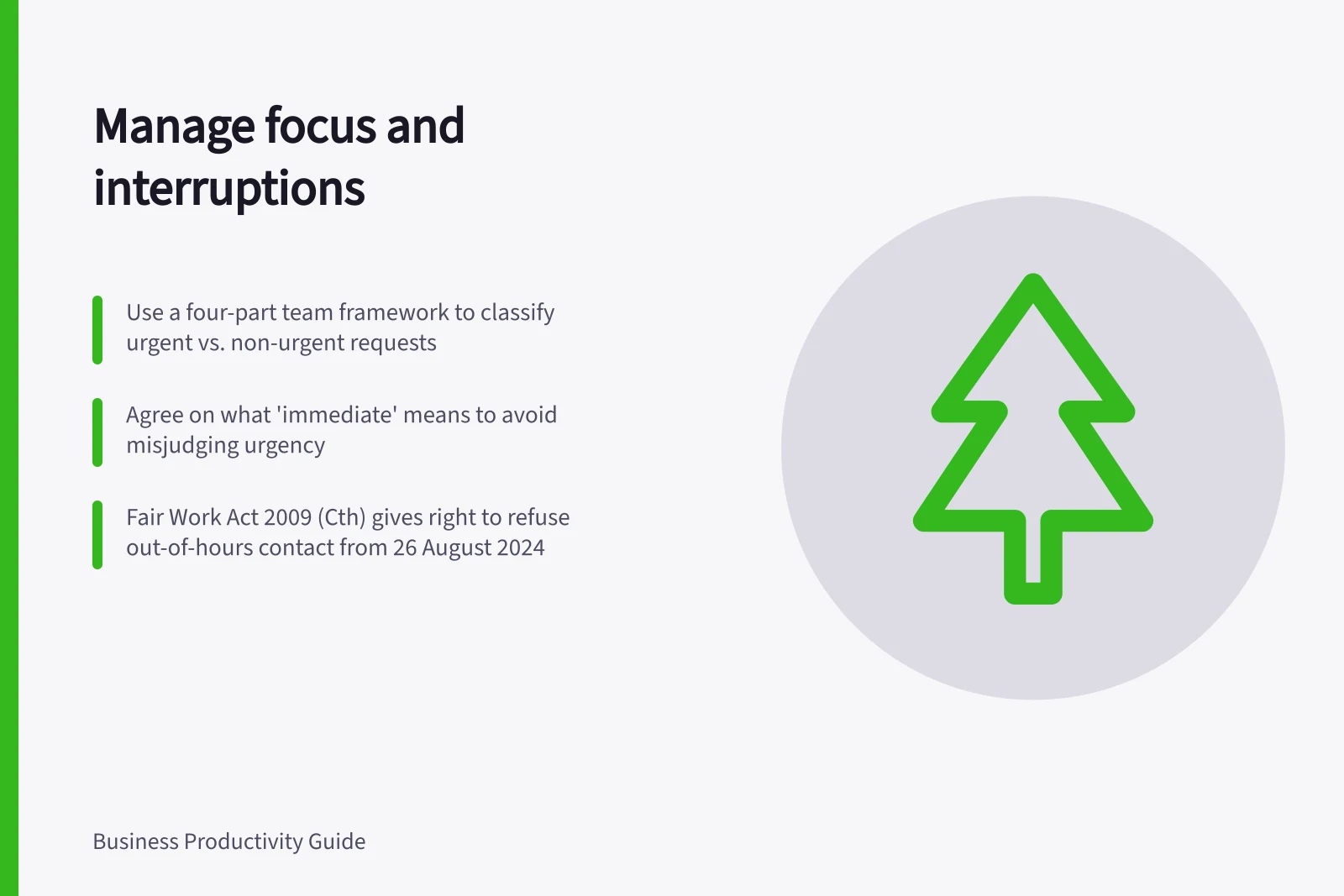
Use a four-part team framework: classify what needs an immediate response, assign an on-duty owner, protect focus for other work, then review how the arrangement performs. The aim is to keep necessary contact on a dependable route without treating every incoming request as urgent.
Distinguish necessary contact from avoidable disruption
A customer issue handled by the person on duty is part of that person’s job. The same issue sent to every project team member may interrupt people who cannot help. A colleague’s question may be necessary without needing an immediate answer.
Start with the consequence of waiting. If a delay could affect a live service, safety or an agreed handover, use the established response route. If the request can wait until the next ordinary check, put it where the owner will find it. Do not ask people to infer urgency from a sender’s tone or a notification sound.
Agree and share what “immediate” means for the team. Route requests that meet the agreed criteria to the person on duty; direct other requests to their owner for the next ordinary check.
Repeated or rapid switching that makes concentration and completion difficult signals that work organisation may need attention. Where interruptions are frequent or prolonged, examine work design rather than treating them solely as an individual concentration problem. Ask the people doing the work which tasks need sustained attention and where those duties collide.
Task switching can impair one or both tasks, even when the work is familiar or predictable, because attention is capacity-limited; sudden or urgent events can also pull attention away from the task at hand. The average adult receives at least 46 smartphone push notifications a day, roughly one every 20 minutes during waking hours, and research links attention-grabbing features to increased stress and reduced productivity.
Impact of Daily Notifications on Focus and Wellbeing
- Average daily smartphone notifications (adults)
- 46
- Frequency of notifications during waking hours
- Approximately one every 20 minutes
- Link to stress and reduced productivity
- Research confirms attention-grabbing features contribute to both
Give every response route an owner
For each immediate-response route, identify who is on duty and where the request goes during a handover. Share that decision with colleagues who rely on the service, so coverage does not depend on guessing.
| Situation | Team decision to make |
|---|---|
| Live service need | Who is covering it now, how are they reached and who takes over if unavailable? |
| Ordinary request | Where does it go, when is it reviewed and who replies? |
| Focused work | When is the worker less available, and who covers their time-sensitive duties? |
A calendar block or muted notification is useful only when the coverage decision is real. If everyone remains responsible for the same queue during a focus block, the team has changed a display setting, not the work. If no one can cover, plan a smaller task that can be paused safely or reconsider the competing commitments.
Out-of-hours contact and flexible work
The Fair Work Act 2009 (Cth), amended by the Fair Work Legislation Amendment (Closing Loopholes No. 2) Act 2024, gives employees a right to refuse to monitor, read or respond to employer contact outside working hours when the refusal is not unreasonable. The right commenced on 26 August 2024 for businesses with 15 or more employees and on 26 August 2025 for small business employers.
Whether a refusal is unreasonable depends on why contact was made, its mode and level of disruption, compensation for out-of-hours work, the employee’s role and responsibility, and personal circumstances including caring responsibilities. Section 333M of the Fair Work Act sets out these factors.
The right does not stop employers sending messages outside working hours. Start with workplace-level discussion; if a dispute remains unresolved, it can go to the Fair Work Commission. The Fair Work Ombudsman is also a body associated with administering the Act, which sets the National Employment Standards (NES).
Make focused periods usable
Choose work that benefits from sustained attention and identify what would count as progress: a checked draft, a resolved technical question or a review ready for another person. Allow enough time to reach a sensible stopping point and leave a brief note of the next step before switching away. The period need not be identical for every role or every day.
Tell colleagues where to place ordinary questions and how genuine exceptions will reach the person on duty. People who serve customers directly may need short blocks around demand or a rotation with a colleague. Someone preparing a complex deliverable may need a longer period. Agree the arrangement with those who depend on the service and the result.
Time-boxing is one way to structure a focused period: it allots a box of time to a given task or activity and blocks it off on the calendar. Setting clear time limits helps teams and individuals reach a stopping point.
Review the whole arrangement
Try one change on a defined type of work, then inspect a few comparable cases. Did the intended work move forward? Were service requests still answered by the right person? Did colleagues wait longer for essential help, or did interruptions shift to someone else? Ask the people receiving the work as well as those producing it.
If the same urgent duty repeatedly breaks every planned block, revisit staffing, coverage, scope or deadlines. More calendar protection cannot create capacity. If the arrangement works for one role but burdens another, adjust the handover rather than judging it by one person’s quieter day.
The Fair Work Act 2009 (Cth) provides a safety net of minimum entitlements, enables flexible working arrangements, provides fairness at work and prevents discrimination.
In this guide
- Identifying the main sources of avoidable interruptionsTrace interruptions to their causes with a brief work-level review, then choose a change that preserves necessary service.
- Planning focused work around service responsibilitiesProtect time for detailed work by mapping service duties, assigning real coverage and reviewing both delivery and customer response.
- Setting team expectations for response timeAgree on response windows, ownership, working hours and escalation so ordinary requests and live service issues reach the right person.