Prioritisation
Agreeing on completion criteria for a deliverable
Write observable completion criteria with the recipient, separate standing quality checks from deliverable-specific needs and manage changes clearly.

Section
Prioritisation
Write observable completion criteria with the recipient, separate standing quality checks from deliverable-specific needs and manage changes clearly.
Prioritisation
Choose one productivity problem using its consequences, available evidence and ability to act, then investigate without assuming the cause.
Prioritisation
Review original commitments, completed results and work added later without hiding approved changes or unfinished dependencies.
Prioritisation
Set up a fair trial of direct assignment and a shared intake queue, then compare ownership, usable resolution, quality and effort.
Prioritisation
Assess an urgent work request against current commitments, identify the response window and agree on what moves if it takes precedence.
Prioritisation
Make a realistic weekly plan by explicitly deferring, reducing, transferring or stopping work that will not fit.
Prioritisation
Define a knowledge-work output by its recipient and use, then check quality before relying on counts or claiming a wider outcome.
Prioritisation
Use current commitments, available skills and an agreed work order to tell whether a team needs clearer priorities, more capacity or both.
Prioritisation
Trace scheduled work to usable outputs and intended outcomes without treating a full calendar or unfinished tasks as a productivity score.
Prioritisation
Define the work, state a useful estimate and its assumptions, separate effort from delivery time, and update the forecast when the basis changes.
Prioritisation
Turn a vague assignment into a usable result with clear authority, inputs, boundaries and an early checkpoint.
Prioritisation
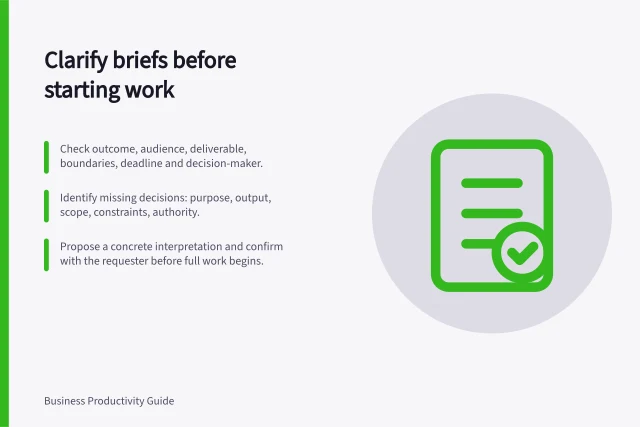
Spot missing outcomes, audience, scope and authority in a work brief, then ask focused questions before committing to the deliverable.
Prioritisation
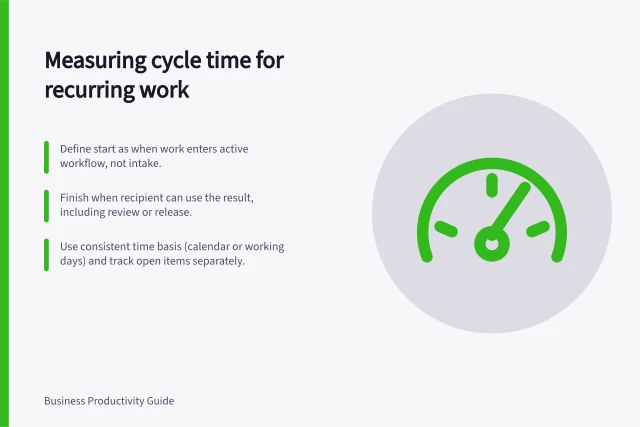
Define start and finish points, track comparable work and interpret cycle time without hiding open items or quality problems.
Prioritisation
Build a personal work plan around commitments, next actions, available time and review points, then adjust it when the work changes.
Prioritisation
A practical guide to managerial productivity: make timely decisions, set clear outcomes, review useful progress and remove obstacles.
Prioritisation
Choose useful team productivity measures and interpret completed work alongside quality, changed demand and employee feedback.
Prioritisation
Find the decisions that need your authority, prepare them for review and protect time to answer without becoming the team's bottleneck.
Prioritisation
Check the real state of unfinished work, decide what to advance, wait on, revise or close, and leave a clear starting point for next week.
Prioritisation
If every message is marked urgent, people cannot tell which one needs immediate action. Define urgency by impact and response time, then route it differently from routine status.
Prioritisation
Plan useful work at a pace the team can maintain. Account for real capacity, deadline pushes, recovery and effort shifted to other roles.
Prioritisation
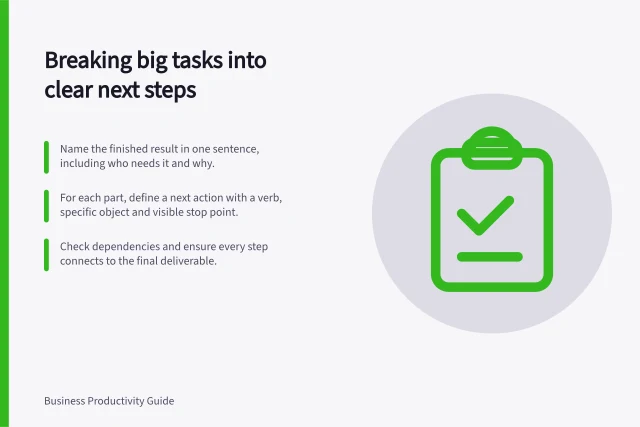
Define a deliverable, divide it into checkable parts, identify next actions and dependencies, and check that the parts produce the agreed result.
Prioritisation
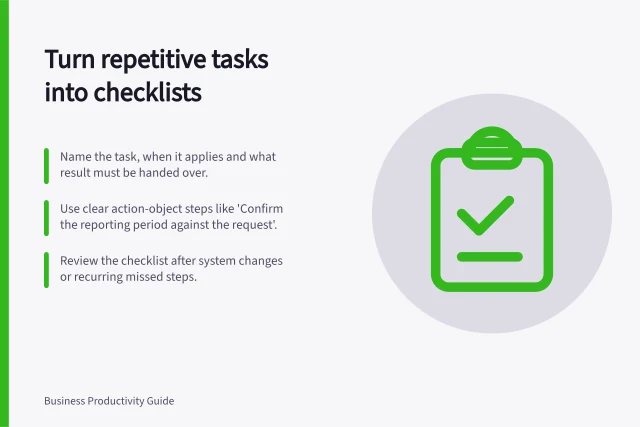
Define the task, select the checks that matter, write clear actions and review the checklist against real work.
Prioritisation
A practical way to order team work, handle new requests, make trade-offs visible and review priorities against real capacity.
Prioritisation
Write a work request that names the owner, needed result, relevant context, timing and place for the answer.