Prioritisation
Part of Personal work planning
Estimating work without pretending the estimate is certain
Define the work, state a useful estimate and its assumptions, separate effort from delivery time, and update the forecast when the basis changes.
A useful work estimate says what work it covers, how much effort it may take and what could change that judgement.
Keep effort separate from the date someone can receive the result. Waiting for an input or review can extend delivery without adding the same amount of hands-on work.
Define what you are estimating
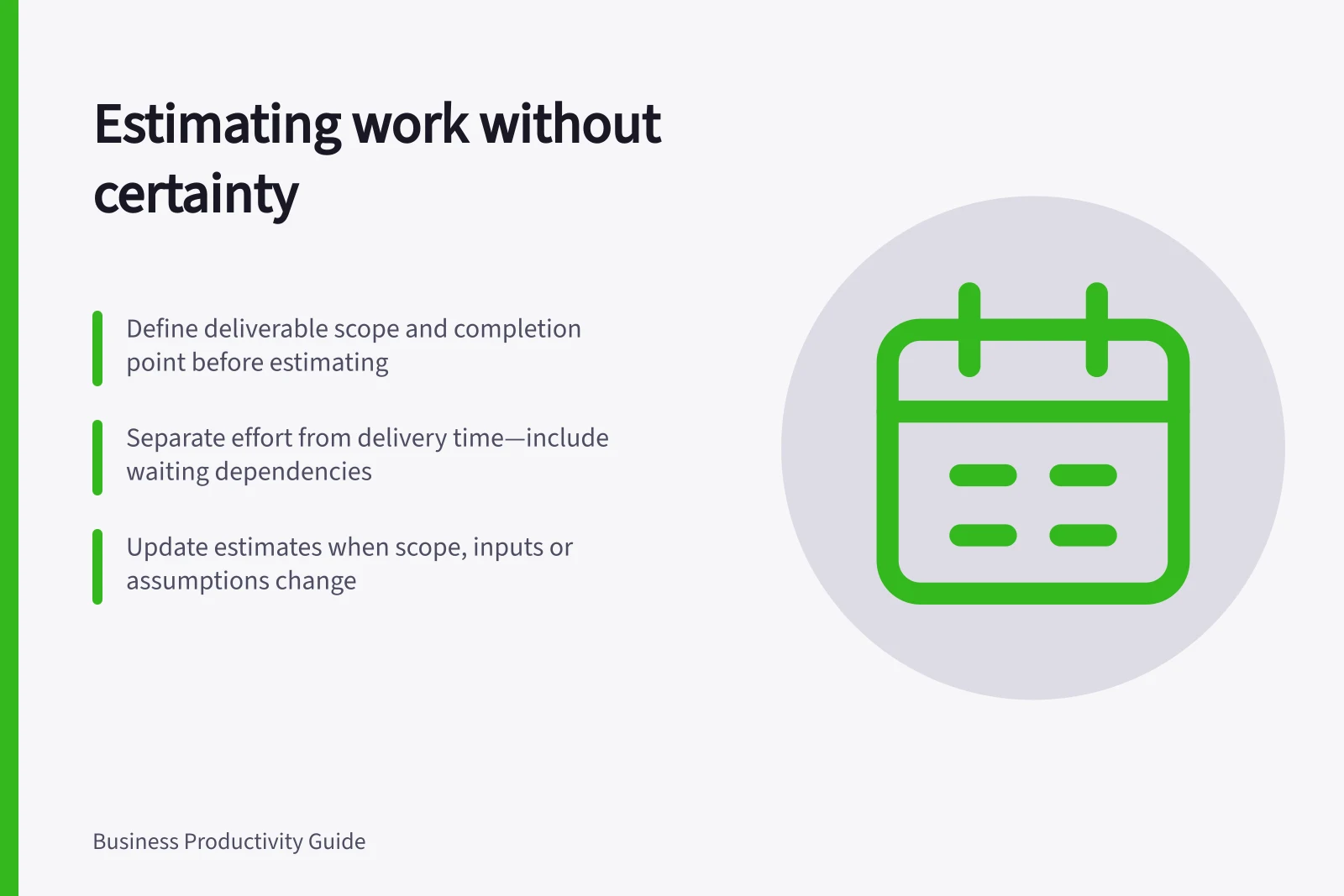
Name the deliverable and the point where your estimate ends. Does it include gathering inputs, drafting, checking, approval and corrections? If people mean different things by ‘complete’, settle that boundary before discussing a duration.
Use comparable previous work when you have it, noting differences in complexity, information and review. If there is no useful comparison, call the estimate an initial planning judgement and choose an early point to learn more. An unfamiliar task does not become predictable because it has been divided into arbitrary small numbers.
Explain the uncertainty
Where a range is useful, give lower and upper planning cases for the same stated scope and assumptions. Explain what might put the work nearer either end. Keep a change to the job itself, such as adding another region to a report, separate from variation within the original estimate.
For example, someone asked to reconcile a report against an approved source might explain that the check and explanation depend on whether that source is current. If the figures use a different definition, the owner of that definition will need to settle it first, and the estimate will be revised. This is a hypothetical illustration, not a standard duration.
Sometimes there is too little information to give a defensible range. State what is unknown, propose a short investigation or first checkpoint, and say when you can estimate the remaining work. Avoid a probability or a confident delivery phrase unless you have a sound basis and the recipient understands what it means.
Pros and cons of using a range in estimates
- ProsHelps set realistic expectations; supports decision-making under uncertainty.
- ConsMay be misinterpreted as a probability; can create confusion if not clearly explained.
Separate effort from delivery time
A small amount of checking may span several days if it waits for approval. A deadline expresses when the result is needed; it does not show how much effort the work requires. Note dependencies and availability beside the effort estimate.
An estimate note can include:
- Result and boundary:
- what is included and excluded.
- Effort:
- an approximate amount or planning range, if one can be supported.
- Waiting and availability:
- inputs, reviews and other commitments affecting delivery.
- Assumptions:
- conditions on which the estimate depends.
- Next update:
- when you expect better information.
Use only the detail the decision needs. A familiar minor task may need one assumption; unfamiliar work with several dependencies needs a fuller conversation. If someone requires a firm date, discuss capacity, scope and a possible smaller interim result before making that commitment.
Key elements of a transparent work estimate
- Result and boundary
- What is included/excluded in the deliverable
- Effort
- Estimated hours or planning range
- Waiting and availability
- Dependencies like approvals or input timing
- Assumptions
- Conditions on which the estimate depends
- Next update
- When better information will be available
Update the forecast when the basis changes
Compare what you learn with the original boundary. If work is taking longer within the stated uncertainty, give an updated forecast and reason. If scope, inputs or the review route changed, explain that separately.
Tell the person relying on the date while there is still a choice about timing or scope. Keep the earlier estimate in the work record so the change can be understood.