Prioritisation
Part of Productivity measurement
Comparing planned work with completed outcomes
Review original commitments, completed results and work added later without hiding approved changes or unfinished dependencies.
Compare what was agreed for a period with what people could use by its end. Keep the starting plan visible, record additions and approved changes separately, and examine unfinished commitments. A completion percentage without those distinctions can misdescribe the work.
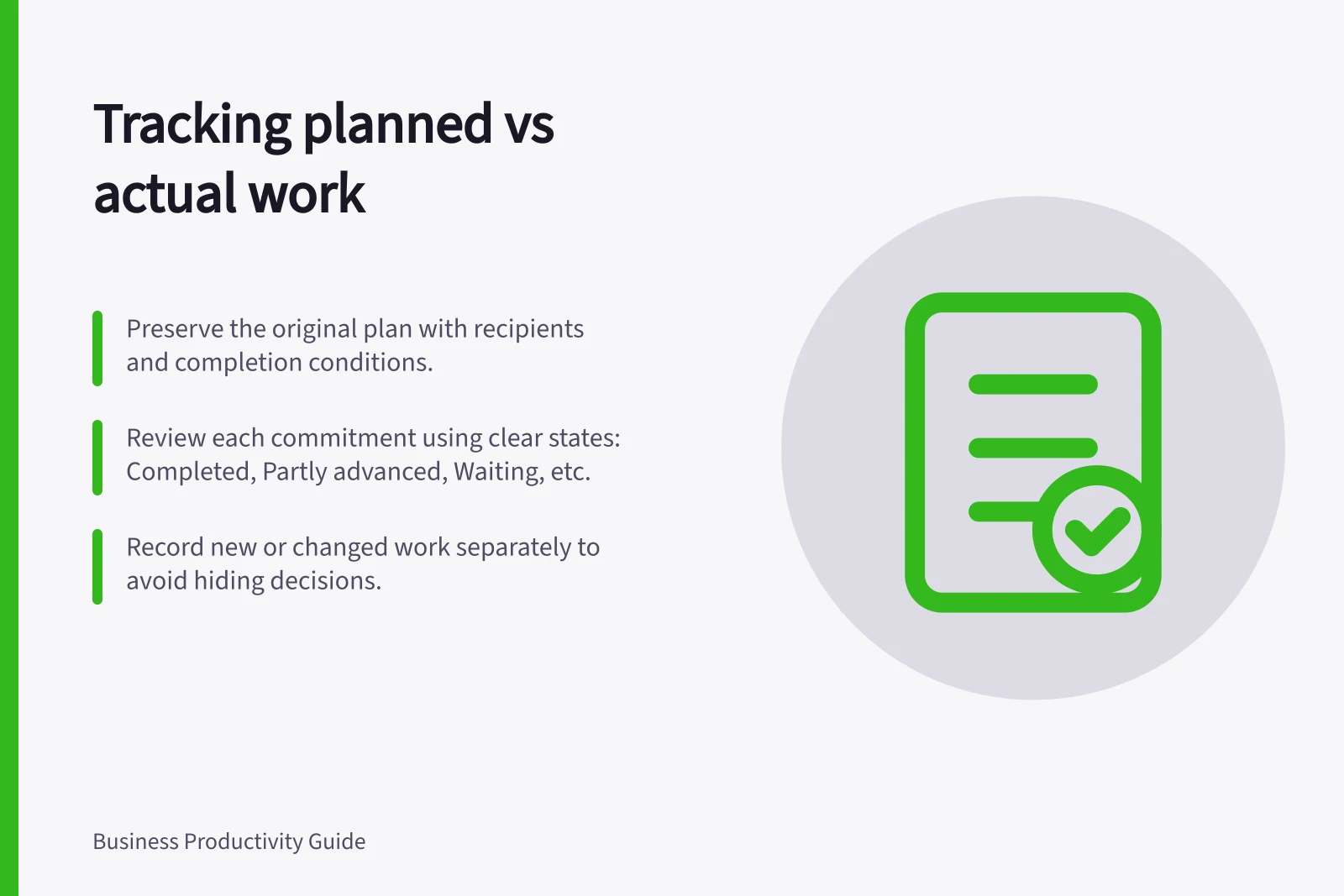
Preserve the starting plan
At the start of a useful period, name each intended result, its recipient and the condition that makes this period's commitment complete. Record the agreed review date and who can change the commitment. Include recurring service coverage and required reviews when they compete for capacity, even if they are not project deliverables.
A longer project may have a usable checkpoint this week without being finished overall. Preserve the original plan so later additions do not silently rewrite what was promised.
Review each commitment
At the end of the period, inspect the result or work record and give each starting item a current state:
| State | Question to settle |
|---|---|
| Completed | Could the intended recipient use the agreed result or checkpoint by the review point? |
| Partly advanced | What usable stage was reached, and what remains? |
| Waiting | Which input, decision or review is missing, and who owns it? |
| Deliberately changed | Who approved the new scope, timing or owner, and who was told? |
| No longer required | Who decided to stop it? |
Do not call a draft complete if approval was part of the agreed result. A completed deliverable is also distinct from its later business effect; record that later outcome only when it can be observed.
Show new work beside the plan
Record urgent or newly discovered work added after planning, what it displaced and whether the change was authorised. Necessary unplanned service work still matters even when it was absent from the project list.
Imagine a team planned a checked report and two customer handovers. A live service issue arrived and the report owner was reassigned. At review, the handovers were complete, the report unfinished and the service issue resolved.
The useful questions are who agreed to move the report, whether its recipient was told and whether the revised commitment is workable. Calling the week 'two out of three' would hide that decision.
If a rate helps, define its denominator as the items in the original plan and identify which of those met their agreed completion rule. Show approved changes and added work alongside it. Counts give unlike items equal weight, so use a rate to prompt review, not to rank teams with different work.
Timeline of Work Changes in a Sprint
- Mid-Sprint
- Service issue discovered; report owner reassigned
- End of Sprint
- Handovers completed, report incomplete, service issue resolved
Use the gap to improve the next commitment
For repeated gaps, inspect examples. Was review time omitted? Did new requests bypass the priority owner? Did a dependency arrive late? Change the part of planning or handover that the evidence supports.
If essential work repeatedly exceeds available skills and time, take scope, dates, coverage or resourcing to someone authorised to change them. For the next period, record the specific change agreed and check whether it addresses the gap.