Team Workload
Part of Productivity measurement
Using employee feedback without treating it as objective output
Ask employees about workflow friction, interpret responses fairly and keep reported experience distinct from recorded output.
Use employee feedback to learn how work is experienced and where to investigate friction. Ask specific questions, protect a route for candid responses, and compare themes with work records and conversations. An account of pressure or unclear instructions is evidence about someone's experience, not a count of completed output.
Ask about a condition workers can describe
If a cycle-time chart shows a long wait, ask where items tend to stop and what information is missing. If completed work returns, ask which requirement or review arrived late.
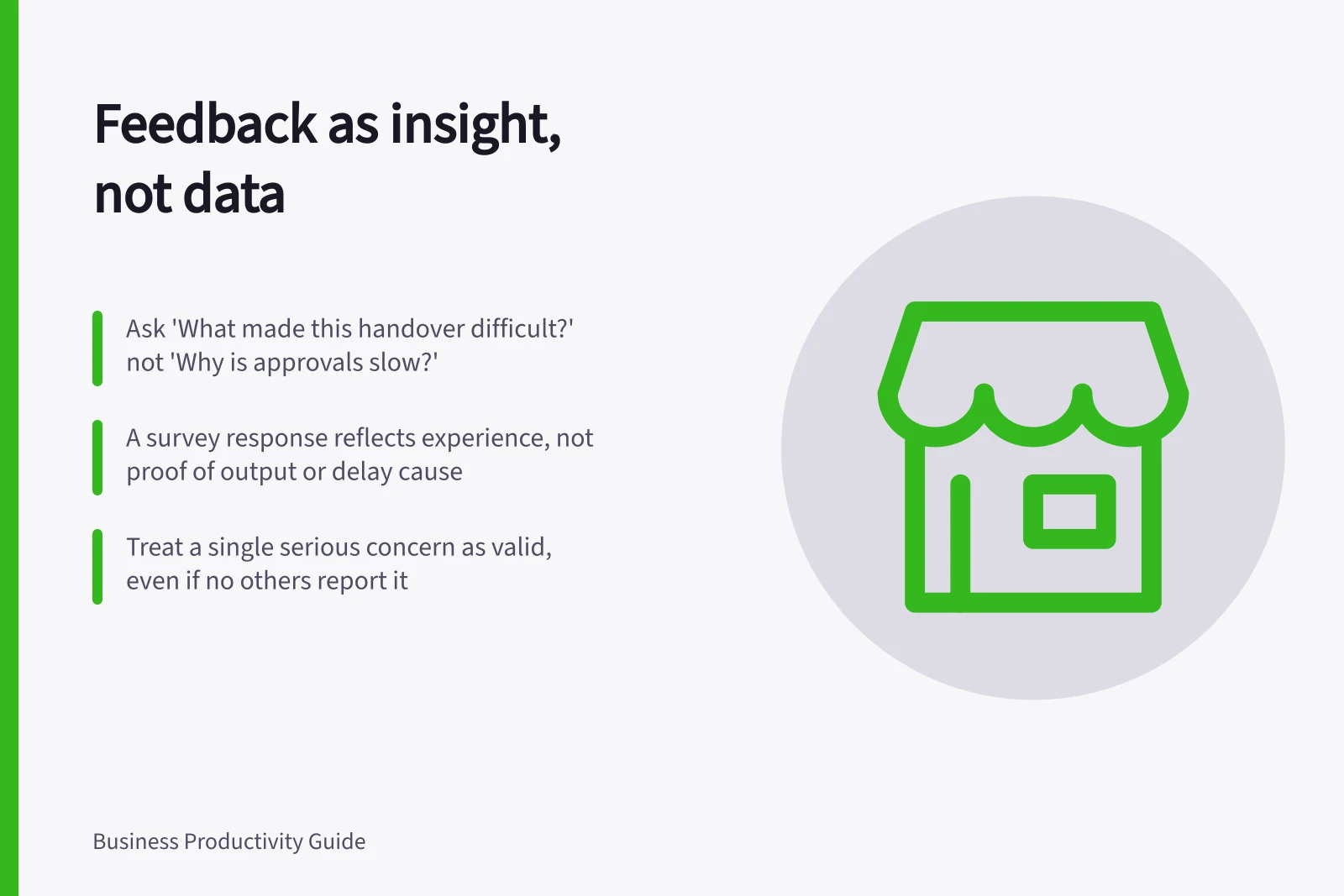
A neutral question such as ‘What made this handover difficult?’ leaves room for an unexpected answer. Asking ‘Why is the approvals team slow?’ supplies a diagnosis before hearing from those involved.
A short discussion may suit a small group. A survey may help people raise concerns across roles or locations, but anonymity depends on collection, access and reporting arrangements. Explain those arrangements before asking.
Do not promise anonymity that the method cannot provide or publish free-text comments from a group small enough to identify the writer.
Interpret responses fairly
A survey response records an opinion or reported experience at a point in time. It can identify an issue worth examining; it cannot establish how many usable outputs were produced or prove what caused a delay. Note who was invited, who responded and whether some roles or shifts may be missing before calling a theme team-wide.
Avoid combining unlike questions into a single ‘productivity sentiment’ score. A worker may report good progress and unsustainable effort in the same period. Preserve both observations. A change in sentiment after a process change also does not, by itself, establish causation.
Treat a serious concern as a concern even if one person raises it. Deciding whether a possible work-design risk needs attention is different from estimating how common an opinion is.
Check a theme and respond
Suppose several workers say approvals arrive too late. Inspect relevant handovers: when was review requested, what did the approver receive, when did the answer arrive and what did the recipient need? Speak with the approver and affected workers.
The record might point to a queue, an unclear question or a required check that was not allowed enough time. These are possibilities in an illustrative case.
Use what you learn to choose a response, such as a clearer request, an earlier decision point or a capacity discussion. Tell workers what was heard, what will change, who owns it and when it will be reconsidered. Explain a constraint if a suggestion cannot be adopted, without exposing an individual's response.
In reviews, label employee accounts as feedback and item times or completed deliverables as recorded workflow data. Compare them to frame questions; neither substitutes for the other. Where workers describe potentially harmful demands, consult them and follow the appropriate workplace process.
Employee feedback vs. recorded workflow data
- Employee Feedback
- Describes lived experience: pressure, confusion, delays
- Recorded Workflow Data
- Measures actual outputs: task completion times, deliverables