Team Workload
Part of Reducing rework
Tracking why completed work repeatedly returns
Keep a simple return record, investigate repeated reasons and check whether a targeted process change prevents the same rework.
When work marked complete comes back, record what returned, the reason given and when the issue could reasonably have been found. Look for repeated reasons, then check the underlying briefs, versions and hand-offs before choosing a fix. A tally shows where to investigate; it does not establish the cause.
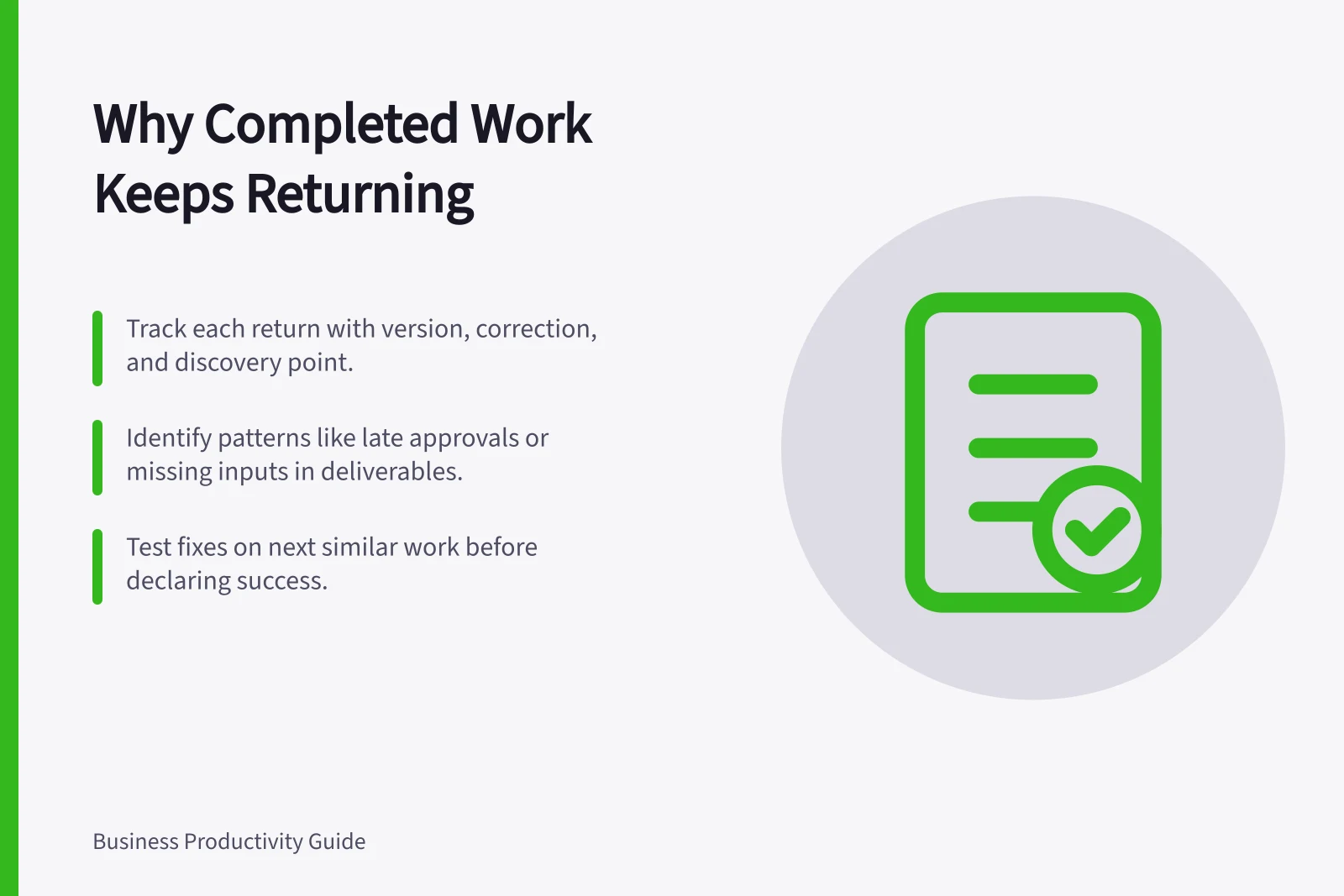
Keep a small return record
Start with one recurring deliverable and a limited review period. Use the team’s existing work record if possible. For each return, capture:
| Field | What to record |
|---|---|
| Work item | The deliverable and version handed over |
| Return | The requested correction or addition, using the requester’s wording where practical |
| Agreed basis | The relevant brief, criterion or approval |
| Discovery point | When the issue could reasonably have been noticed |
| Next action | The immediate response and who owns it |
Use plain descriptions, not speculative cause codes. After examining several returns, group observable patterns such as missing inputs, conflicting instructions, late approval or an incomplete hand-off. Keep new requests and expected iteration separate from avoidable repetition.
Investigate the pattern
Suppose several reports return because a figure changes. Check which source version each report used, when the authoritative figure became available and who was expected to approve it. The maker may have followed the agreed process.
A data cut-off after the drafting deadline or an unannounced source change could also explain the returns. These are possibilities in a hypothetical case, not findings about any team.
For each likely cause, ask what evidence supports it and what other explanation fits. More than one cause may contribute. Adding a checklist before examining the data hand-off could add work without preventing another return.
Choose a process change that fits the evidence. A missing requirement may call for a clearer brief; a late approver may need an earlier review point; a recurring export error may need a source check. Give the change an owner and a date to revisit it.
Check the next comparable work
Look at later deliverables of the same type. Ask whether the particular reason still appears, whether a different return has emerged and whether the new step adds disproportionate effort. A quiet week is too little evidence to declare the issue solved. If the pattern persists, revisit the assumed cause before adding another control.
Describe findings in terms the team can act on: “The approved data arrived after the draft was marked complete” identifies a hand-off to examine. The record is useful when it leads to a tested change in the process, not a ranking of people.