Prioritisation
Part of Reducing rework
Identifying unclear briefs before work begins
Spot missing outcomes, audience, scope and authority in a work brief, then ask focused questions before committing to the deliverable.
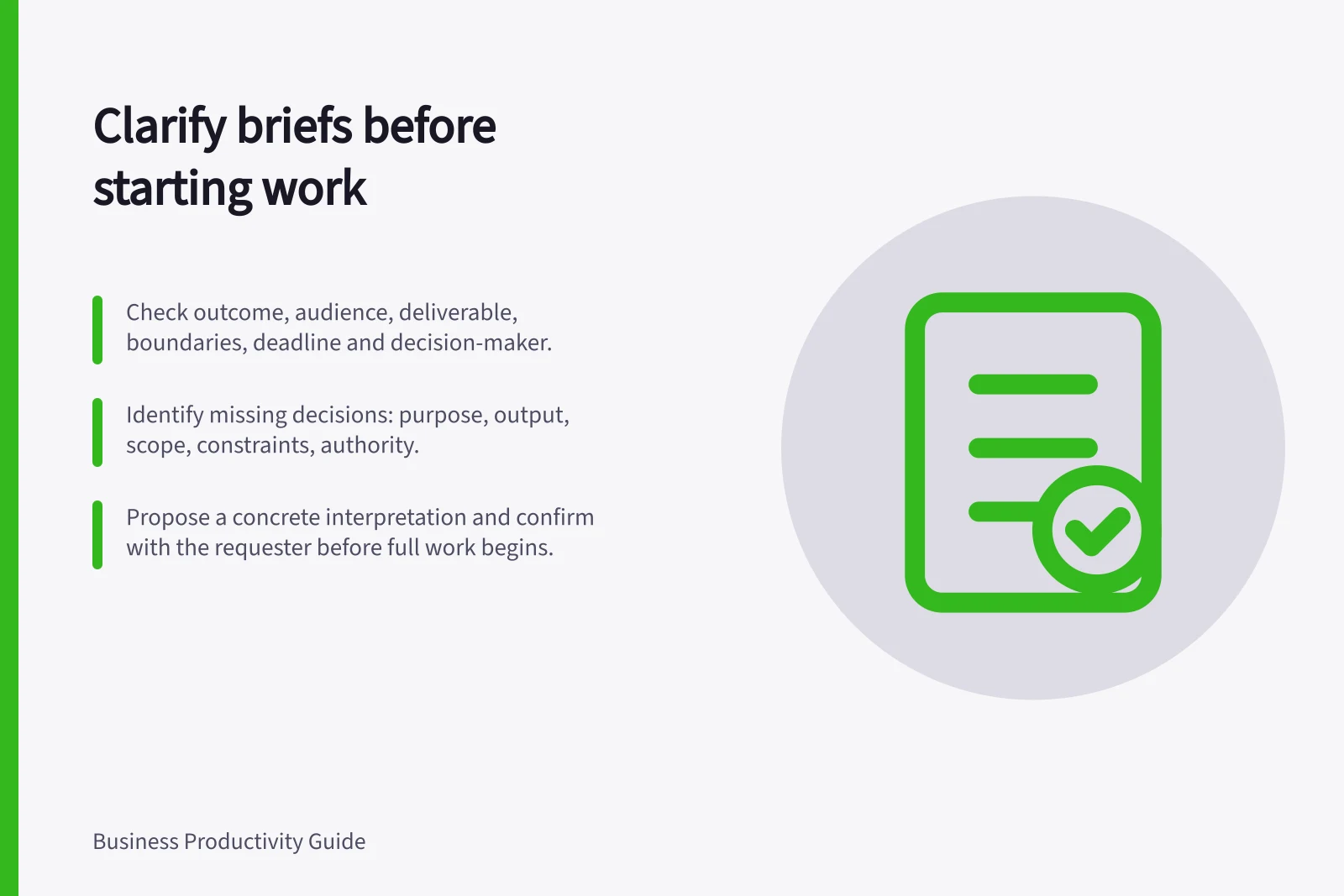
Before substantial work begins, check you can state the intended outcome, audience, deliverable, boundaries, deadline and the person who can settle open questions. If you cannot, send the requester a short proposed interpretation and ask them to correct it before the team commits to the full job.
Find the decisions the brief has not made
A brief may list activities yet leave the result open to interpretation. “Prepare a presentation for leadership” does not say what leadership needs to understand or decide.
“Refresh the customer report” may omit the reporting period, data source or reviewer. Different reasonable assumptions could then lead to different outputs.
Mark anything you would otherwise have to guess:
- Purpose and audience:
- Who will use the result, and for what decision or task?
- Output:
- What will be handed over, in what format and level of detail?
- Scope:
- What belongs in this request, and what is outside it?
- Constraints:
- Which dates, inputs, approvals or technical limits are fixed?
- Authority:
- Who can resolve questions or choose between conflicting directions?
Treat these as prompts, not a compulsory form. A routine correction may need one clear sentence; work with several stakeholders may need a more explicit record.
Ask a question the requester can answer
Offer a concrete interpretation instead of asking only, “Can you clarify?” For example: “I understand this as a two-page summary for the sales team, covering April to June results using the finance-approved figures. Should it include forecasts?” The example exposes the assumptions the requester needs to confirm or change.
If stakeholders give conflicting instructions, state the conflict and ask the person authorised to decide. If the audience or outcome remains uncertain, propose an outline, sample page or short discovery conversation. Say what that step will test and when the full scope will be confirmed.
Some unknowns can remain open. Give each one an owner and decide whether work can safely proceed.
An unresolved design preference may still allow an outline; an unknown required data source may prevent the report from being completed. Consider how much work would need repeating if the assumption proves wrong.
Close the clarification loop
Put the agreed interpretation where the team will find the brief. Record the outcome, scope, key constraints, open points and decision-maker.
If the request changes, keep a record of the earlier decision so the team can see what changed.
Clarifying the brief establishes what work to do. Agree separately, before full work proceeds, how the recipient will judge the finished deliverable.
Key Risks of Proceeding Without Clarification
- Re-work risk
- High – assumptions may require full redo if wrong
- Deadline impact
- Likely – unclear scope delays delivery
- Stakeholder dissatisfaction
- Common – deliverables miss intended use