Prioritisation
Part of Work prioritisation
Deciding what not to do this week
Make a realistic weekly plan by explicitly deferring, reducing, transferring or stopping work that will not fit.
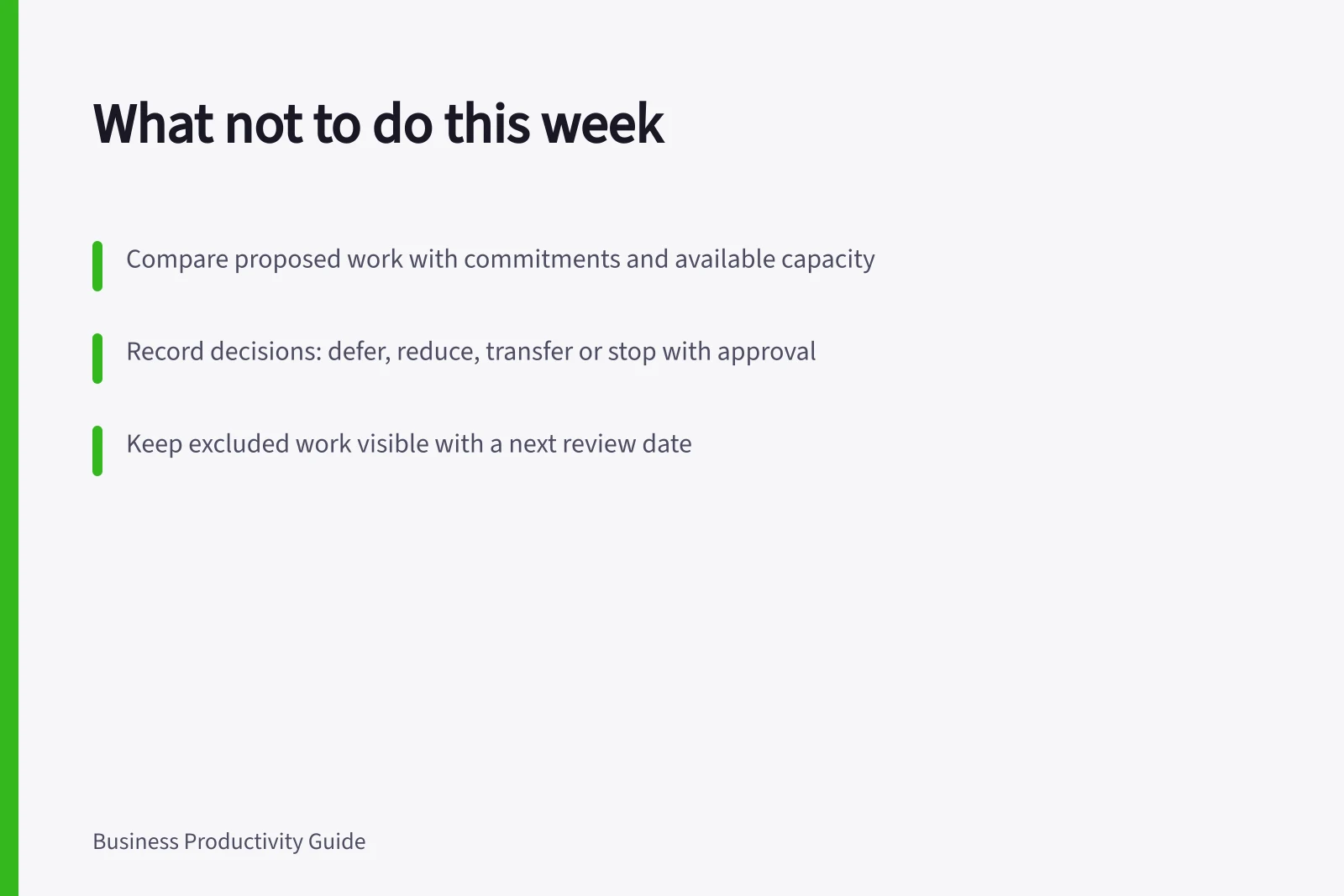
To decide what not to do this week, compare proposed work with commitments and available capacity. For each excluded item, make the decision explicit: defer it to a review date, reduce its scope, transfer it with agreement or stop it with the right approval. A silent omission leaves someone else expecting work that will not arrive.
Start with the week that is available
List results already promised alongside service coverage, essential checks, leave, approvals and work carried over from last week. Ask the people doing the work what remains open and which dependencies could change the plan. Keep enough detail to see trade-offs without estimating every small task.
Separate fixed obligations from preferred dates, and confirm who can change each promise. If two owners have been promised results the team cannot both deliver this week, take the conflict to someone authorised to resolve it. Do not ask the team to absorb it privately.
Key Considerations for Managing Workload in Australian Teams
- Service coverage and essential checks
- Must not be treated as optional
- Leave and approvals
- Part of available capacity
- Work carried over from last week
- Should be reviewed for relevance and urgency
- Psychosocial hazards in work planning
- Overloading teams impacts mental health
Sort the remaining work into decisions
| Response | Use it when | Record |
|---|---|---|
| Defer | The result will still be useful later | Next review date and consequence of waiting |
| Reduce | A smaller result meets the immediate need | What will be delivered now and what remains open |
| Transfer | Another owner agrees to accept the work | Owner, agreement and handover |
| Stop | The result is no longer needed or justified | Decision-maker and people to inform |
A transfer is not complete just because a name was added to a list. Confirm the new owner has the authority, information and capacity to accept it. Do not treat essential checks or service work as optional because they are less visible than a project milestone.
Consider who relies on each excluded item. If a deferred task supplies an input to another team’s plan, tell that team.
Get the relevant approval if stopping work changes a customer promise or agreed scope. If the consequence is unknown, find out before making a decision that would be difficult to reverse.
Options for Excluded Work: When to Defer, Reduce, Transfer or Stop
- Defer
- The result will still be useful later
- Reduce
- A smaller result meets the immediate need
- Transfer
- Another owner agrees to accept the work
- Stop
- The result is no longer needed or justified
Tell people what changed
A short note can state what the team will complete, what has moved, why and when the decision will be revisited. For example: “This week we will complete the client response and cover the service queue. The dashboard redesign moves to the next weekly review. The extra report awaits a scope decision.”
This is an illustrative note, not a report about a real team.
Keep excluded work in the planning view, with its status and next decision point. “Later” without a review date can become an accidental cancellation. At the review, ask whether the reason for keeping an item still holds rather than rolling it forward automatically.
Reopen the plan when conditions change
A live issue, changed customer requirement or unavailable specialist may invalidate the week’s choices. Compare the new demand with what was agreed, then state what moves. If this happens repeatedly, discuss the pattern in team planning rather than rebuilding each week’s list in isolation.
If necessary work repeatedly exceeds available people and reasonable working time, escalate the mismatch in scope, dates or resources. Removing items from a list does not remove the underlying demand.