Prioritisation
Productivity for managers
A practical guide to managerial productivity: make timely decisions, set clear outcomes, review useful progress and remove obstacles.
Managers help a team deliver useful work: settle decisions their role requires, give clear direction, review progress at sensible points and change conditions that block the work.
Start with the decision or support the team needs from you, rather than adding another status request.
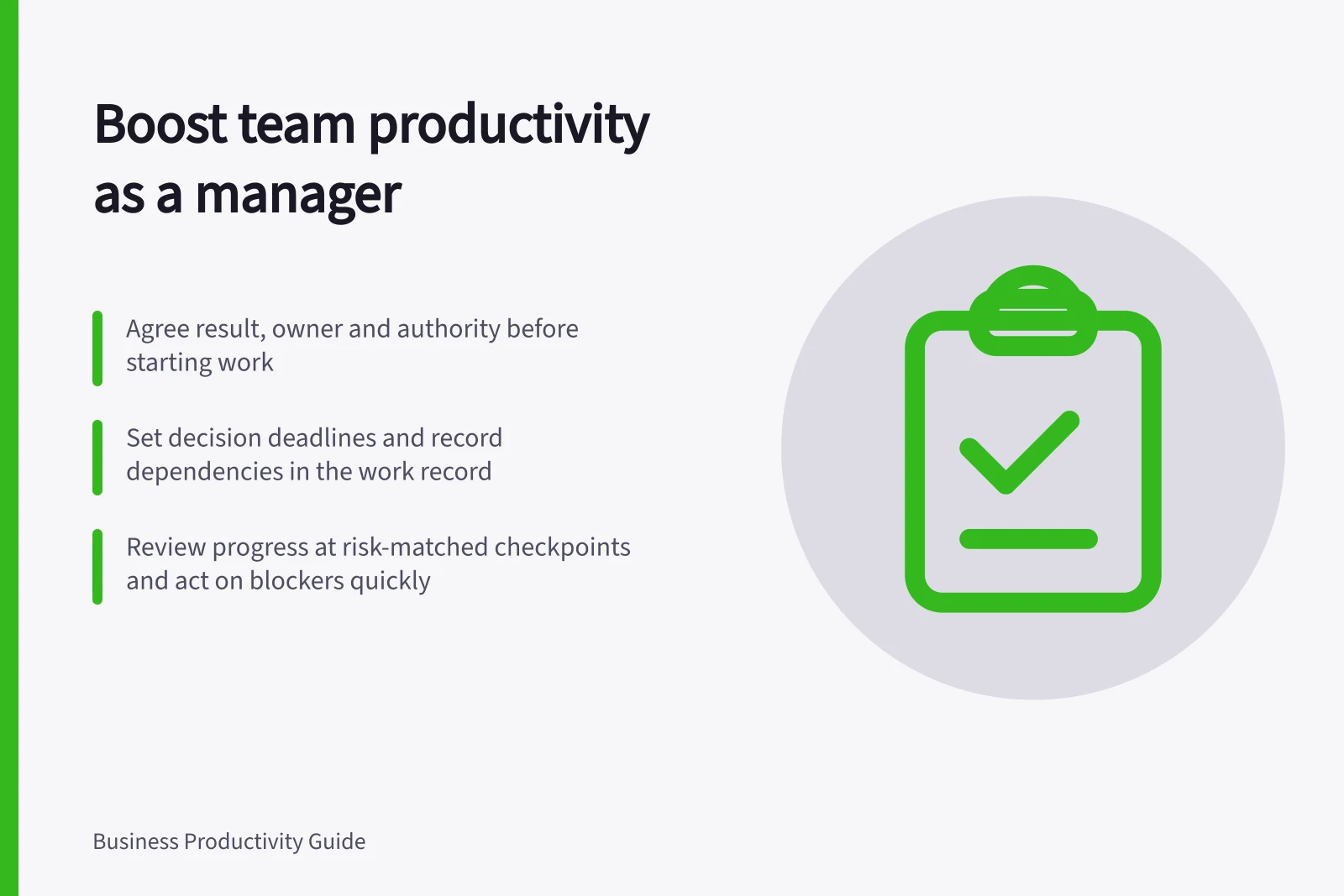
Treat the work as a loop: agree the result, owner and authority; set the next useful check; decide or remove blockers when they arise; then confirm the recipient can use the result.
Decide where your attention is needed
For a decision waiting on you, check who has authority to make it and what information they need. Keep approvals that genuinely belong to your role. Let colleagues make choices they are authorised and equipped to make within agreed boundaries.
Set aside time for decisions only you can settle. Ask for the question, workable options, main trade-offs and latest useful answer time. If someone else must approve the choice, name that dependency and route it to them.
In the team's existing work record, note the decision, who owns it, who has authority to approve it, what input is needed and when an answer is useful. Once settled, record the decision and who will act on it so the work can move.
Give a result people can work towards
When assigning work, explain who will use the result and what it should enable. State the constraints, the owner's authority and a useful point to check direction.
For example, 'improve the handover' leaves the result open; 'propose a handover that lets the service team identify open cases and their next owner' gives the person something to shape.
Check that the owner has the information, access, skills and time needed. Leave room for their judgement about the method unless a particular method is required.
Before work starts, confirm what a usable result looks like, what the owner may decide without approval and which choices need to come back to you. That gives the owner room to act while making the approval boundary clear.
Review work at agreed points
Choose checkpoints that fit the work's duration and risk. Inspect the current deliverable or shared work record. Ask what the recipient can use, what remains uncertain and whether a decision is needed. Agree that material risks can be raised before the next routine review.
Make room for concerns that do not belong in a public status field, including workload and conflicting instructions. Discuss sensitive matters privately.
For short, low-risk work, a check near handover may be enough. Longer or higher-risk work calls for interim checks at points where assumptions, dependencies or risks could change; bring a check forward if they do.
Change what is blocking the work
When progress stops, identify the next step and what prevents it. Missing information may need an answer from its owner; delayed approval may need a decision from the authorised person; incompatible promises may need a priority decision.
If essential work exceeds available time or skills, take a scope, timing, cover or resourcing choice to someone who can make it.
Give the remedy an owner and a next check. Repeated concerns about working conditions deserve attention through the workplace's appropriate risk process, as well as a response to the immediate blocked task.
When a blocker depends on someone else, make the request specific: name the action or decision needed and the latest useful time for it. Tell the work owner what can proceed meanwhile, and revisit the blocker at the agreed check or sooner if the risk changes.
Workplace Health & Safety: Psychosocial Hazards in Australian Teams
- Source
- Safe Work Australia
- Key Risk Areas
- Workload, conflicting demands, poor communication, lack of support
- Response Required
- Use workplace risk processes for repeated concerns
Use a manageable rhythm
At the start of a suitable planning period, confirm the team's committed results and decisions that may hold them up. Make time to answer those decisions and keep an agreed route for genuine exceptions. At review, check what reached its recipient, which promises changed and whether a remedy created a problem elsewhere.
Keep this rhythm in the work record the team already uses.
Run the cycle from planning to completion: assign each result and its decision boundaries, settle decisions by their latest useful answer time, and review at checkpoints matched to duration and risk. Bring reviews forward for material changes or blockers, then close the loop by confirming the result reached its recipient.
A shared project-management workspace can keep tasks, owners, progress, responsibilities and risks together, giving the team a shared view of the work instead of relying on scattered updates.
Top Project Management Tools for Australian Businesses (2026)
- AsanaHighly rated for task tracking and team collaboration
- TrelloPopular for visual workflow management and Kanban-style boards
- Microsoft ProjectUsed by larger organisations for complex project planning
- ClickUpAll-in-one platform with strong integration options
In this guide
- Protecting time for decisions that cannot be delegatedFind the decisions that need your authority, prepare them for review and protect time to answer without becoming the team's bottleneck.
- Giving a clear outcome instead of a vague taskTurn a vague assignment into a usable result with clear authority, inputs, boundaries and an early checkpoint.
- Reviewing progress without constant status requestsUse a shared work record, proportionate checkpoints and clear exception rules to review progress without repeated status chasing.
- Removing an obstacle instead of adding another reportFind the blocked step, choose a remedy that changes it and check whether work can proceed without shifting the problem elsewhere.