Async Work
Part of Knowledge reuse
Finding existing work before creating a new document
Search by purpose, inspect likely matches and decide whether to reuse, update, adapt or start a document from scratch.
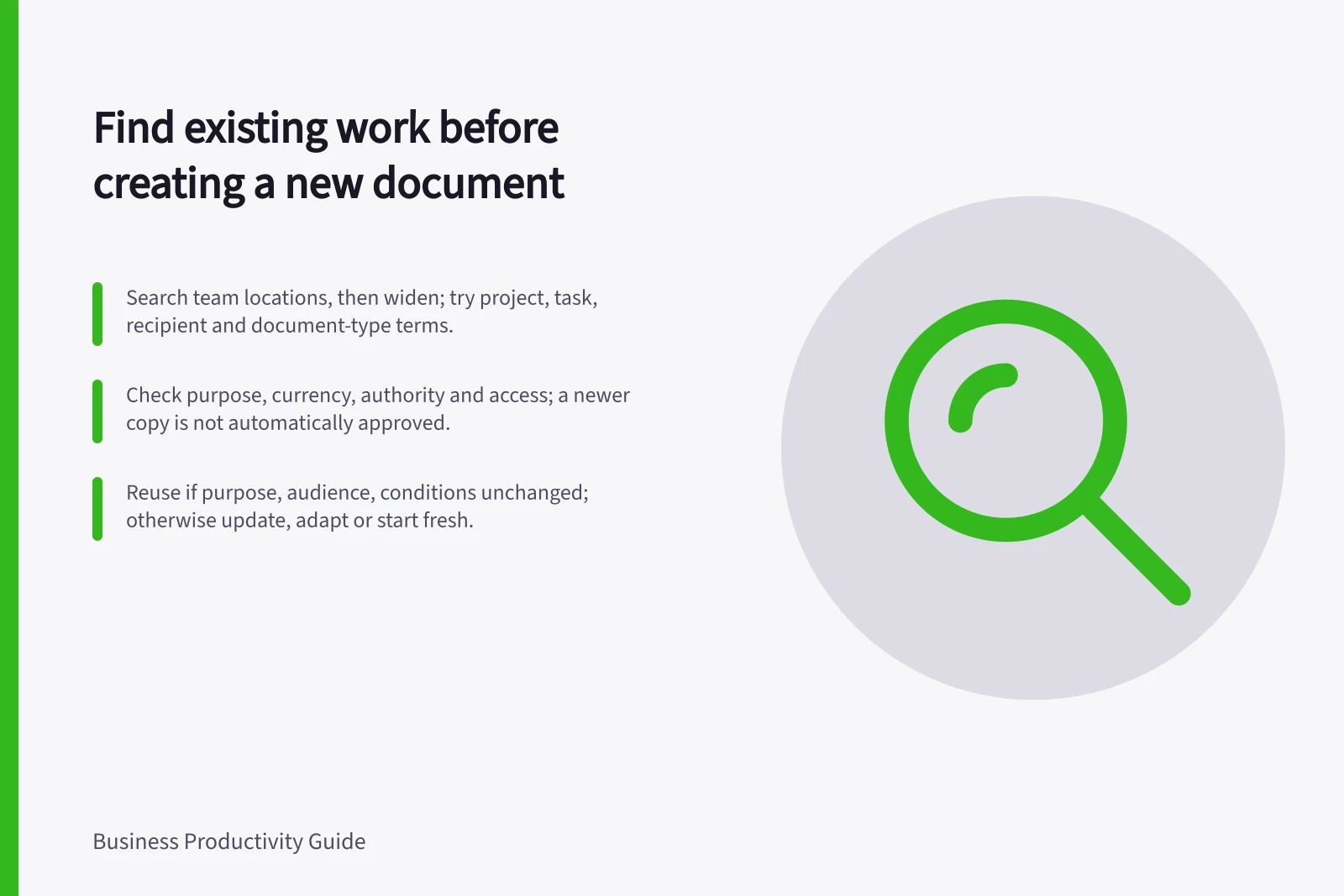
Before you start a new document, check for earlier work with the same purpose, audience or subject. Search using terms colleagues may have used, inspect likely matches and decide whether to use, update, adapt or start fresh. A matching title is only a lead: the file may be outdated, restricted or intended for a different decision.
Search for the job the document did
Describe the result you need in one sentence: who will use the document, and for what? Search the team’s agreed locations, starting with the relevant folder or workspace and then widening the search where access allows.
Start with distinctive terms for the project, task, recipient or document type, then try likely subject wording and alternate terms. For a prior report, a useful query pattern is [project name] report [recipient]; replace the bracketed phrases with the terms your team uses and try them separately as well as together.
Google Drive provides file search, so try the terms there when the team uses Drive. Search results cannot show files you lack access to, and no search proves that every relevant file has been found.
If you have good reason to expect earlier work but find none, ask a colleague who handled it. They may know a different project name or location. Follow the organisation’s access rules before opening or reusing restricted material.
Inspect likely matches
Open promising documents and check:
Check / Question
- Purpose
- Did it solve the same reader problem?
- Currency
- Are its period, process and inputs still applicable?
- Authority
- Was it approved, unfinished or superseded?
- Access
- May it be used for this audience?
Read enough to see why the earlier version took its shape. A customer proposal may offer useful structure, but its terms belong only to that customer. A previous report may identify a data source, but its figures belong to an earlier period.
Look for an approval statement or a notice that the document is unfinished or superseded. If copies conflict, ask the recognised owner or consult the governing record; the most recently modified copy is not automatically approved. If authority is still unclear, get a decision before relying on the content.
What to check before you reuse an earlier document
- Purposedid it solve the same reader problem?
- Currencyare its period, process and inputs still applicable?
- Authoritywas it approved, unfinished or superseded?
- Accessmay it be used for this audience?
- Look for an approval statement, or a notice that the document is unfinished or superseded
- If copies conflict, ask the recognised owner or consult the governing record — the most recently modified copy is not automatically approved
Decide what to reuse
Use the existing item when its purpose, audience and conditions are unchanged and its content is current. Update it when the same shared guidance is still needed but some of its content needs correction.
Adapt a copy when the structure is useful but the case, audience or period differs; for example, reuse a customer proposal’s structure without carrying over that customer’s terms. Start fresh when the earlier item answers another question or its basis cannot be checked.
When you adapt, replace case-specific information, verify current inputs and approvals, and label the new document clearly. If the search was difficult, improve the finding path afterwards with a clearer title, description or agreed location.