Process Experiments
Part of Work process experiments
Stopping an experiment that makes work harder
Set stopping rules, stabilise open work, investigate added burden and decide whether to end or revise a process trial.
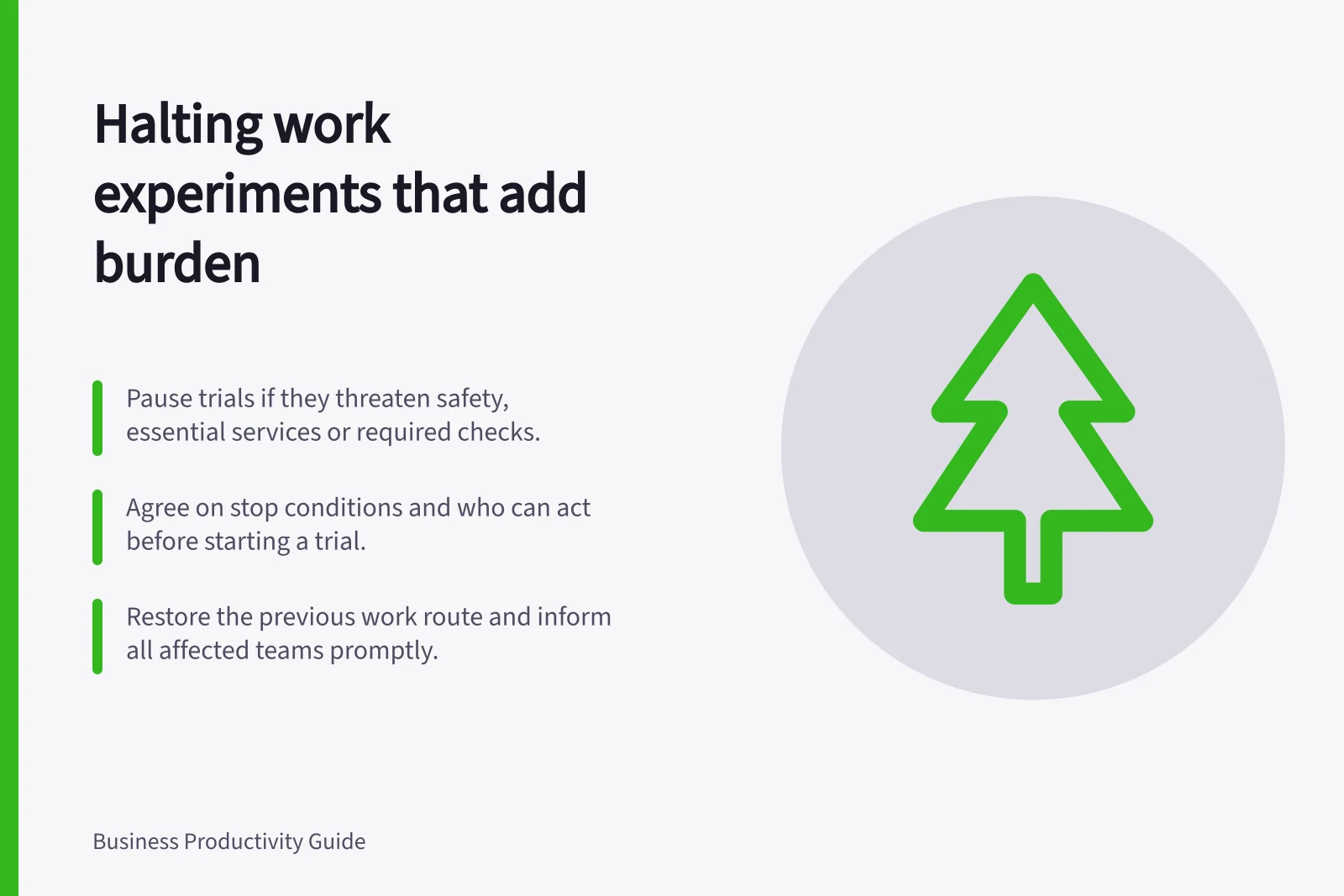
Pause a work process experiment promptly if it threatens essential service, a required check or someone’s ability to do the work safely. For less urgent added burden, arrange a timely review against the trial’s agreed stopping conditions.
In either case, give current work a dependable route, tell affected people what applies and examine the cause before trying another version.
Key sources and guidance
- Safe Work Australia – Psychosocial hazards
- https://www.safeworkaustralia.gov.au/safety-topic/managing-health-and-safety/mental-health/psychosocial-hazards/poor-organisational-change-management
- Safe Work Australia – Reviewing controls
- https://www.safeworkaustralia.gov.au/book/health-care-and-social-assistance/managing-whs-risks/review-controls
Agree on stop conditions in advance
Before a trial begins, name signals that call for immediate action and those that need a prompt review. A live request with no owner, a missed required approval or an unsafe handover may require an immediate pause. Repeated duplicate entry or extra sorting work may call for a short review if work can continue safely meanwhile.
Name who can pause the trial, how workers report a problem and who may approve a revised process. The pause owner needs access to current work and authority to arrange cover. A stopping rule is useful only if someone can act when a live problem appears.
An inconvenience is not automatically a work health and safety hazard. Take concerns about workload, unclear roles or poor support seriously, consult affected workers and use the workplace’s risk process where appropriate.
Stabilise current work
If the trial is causing an immediate problem, tell participants which route governs new work. Identify open items that entered under the trial, their owners, promises made and steps needed to finish or transfer them. Check that the previous route has an available owner, access and cover before restoring it. A change of instructions without a handover can strand requests between routes.
Tell requesters and receiving teams about any changed response or delivery expectation. Keep the message factual: where to send work now, who handles open items and when another update will come. Record the decision where the trial’s work is managed.
Diagnose the added burden
Inspect cases that exposed the problem and ask workers and recipients what happened. Was the rule unclear, the step too slow, the volume higher than expected or a required skill missing? Did work move to another team’s queue? Check these possibilities rather than assuming a cause.
Separate implementation from design. Conflicting instructions may call for a clearer, supported route in a later trial. A route that needs capacity the organisation cannot provide is a different problem. If a necessary control was weakened, address that risk before considering another trial.
Decide what happens next
Record the next state: end the change and retain the former route; revise a defined part and test it under new conditions; or retain only a part that works without the harmful effect. State what evidence supports the decision and what remains uncertain. Tell everyone affected, including people who rely on the trial’s outputs.
A stopped experiment can still reveal a limit on feasibility. Close the loop with people who raised concerns, then check that the restored or revised route is working.