Team Workload
Part of Knowledge reuse
Recording an answer the team repeatedly needs
Turn a repeated team question into a short, checked answer with clear scope, a useful location and an owner.
When colleagues ask the same work question repeatedly, record the checked answer where they will look next time. Put the answer first, then state when it applies, what could change it and who owns it. The useful entry is usually shorter than the conversation that produced it.
Confirm the question
Look at how the question arises in actual work. People may use different words for the same problem, or ask similar questions that need different answers. Write the question in a colleague’s terms and define its boundary.
For example, “Which client handover form should I use for a new account?” is narrower than “How do handovers work?” If account type or an approval changes the answer, put that condition beside it.
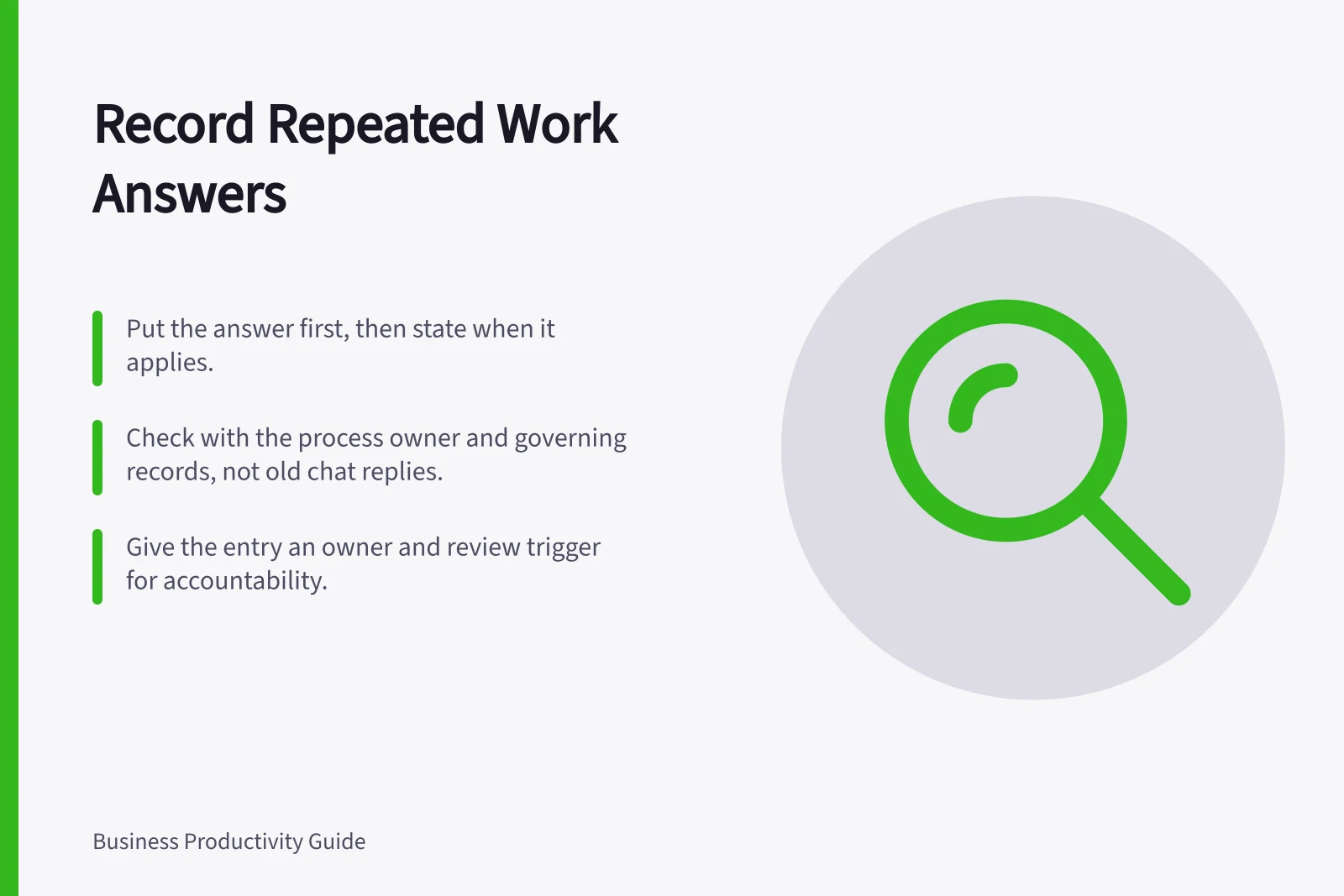
Check the answer with the person responsible for the process and against any governing record. An old chat reply is not enough when the process may have changed. If the answer remains unresolved, label the question as pending and name who will settle it.
Write for the next reader
A short entry can include:
- Answer:the action or rule needed now.
- Applies when:the situation, role or work covered.
- Next step:where to act or find the current form or process.
- Exceptions:what changes the route and who decides.
- Owner:who confirms changes and when the entry should be checked.
Use a title that describes the question. Keep a reference to approved source material where it exists, while making the practical answer understandable without replaying a message thread.
Place and check the entry
Put it in the team’s agreed knowledge location and point to it from the route that generates the question. Check that the intended reader can access it. Remove unnecessary details about the original case before sharing it more widely.
Ask a colleague who did not write the entry to find it using their own search words. Can they tell what to do and whether it covers their case?
If it is hard to find, improve its title or location. If it is easy to find but still prompts the same clarification, make its conditions or next step clearer.
Keep the answer accountable
Give the entry an owner and a review trigger, such as a changed form, policy or handover route. Update the recognised entry when the answer changes and mark obsolete guidance accordingly. Tell frequent users about a material change. Keep an earlier answer if the organisation’s records practice requires it.